
Summary
- The Internet of Things (IoT) is a network of physical objects (“things”) embedded with sensors, software, and other technologies to connect and exchange data with other devices and systems over the internet.
- The internet of things definition goes beyond mere connectivity; it emphasizes the ability of devices to collect data, communicate, and often act autonomously.
- Key components include sensors/actuators, network connectivity (e.g., Wi-Fi, 5G), data processing/storage (cloud/edge), and an application layer for user interaction.
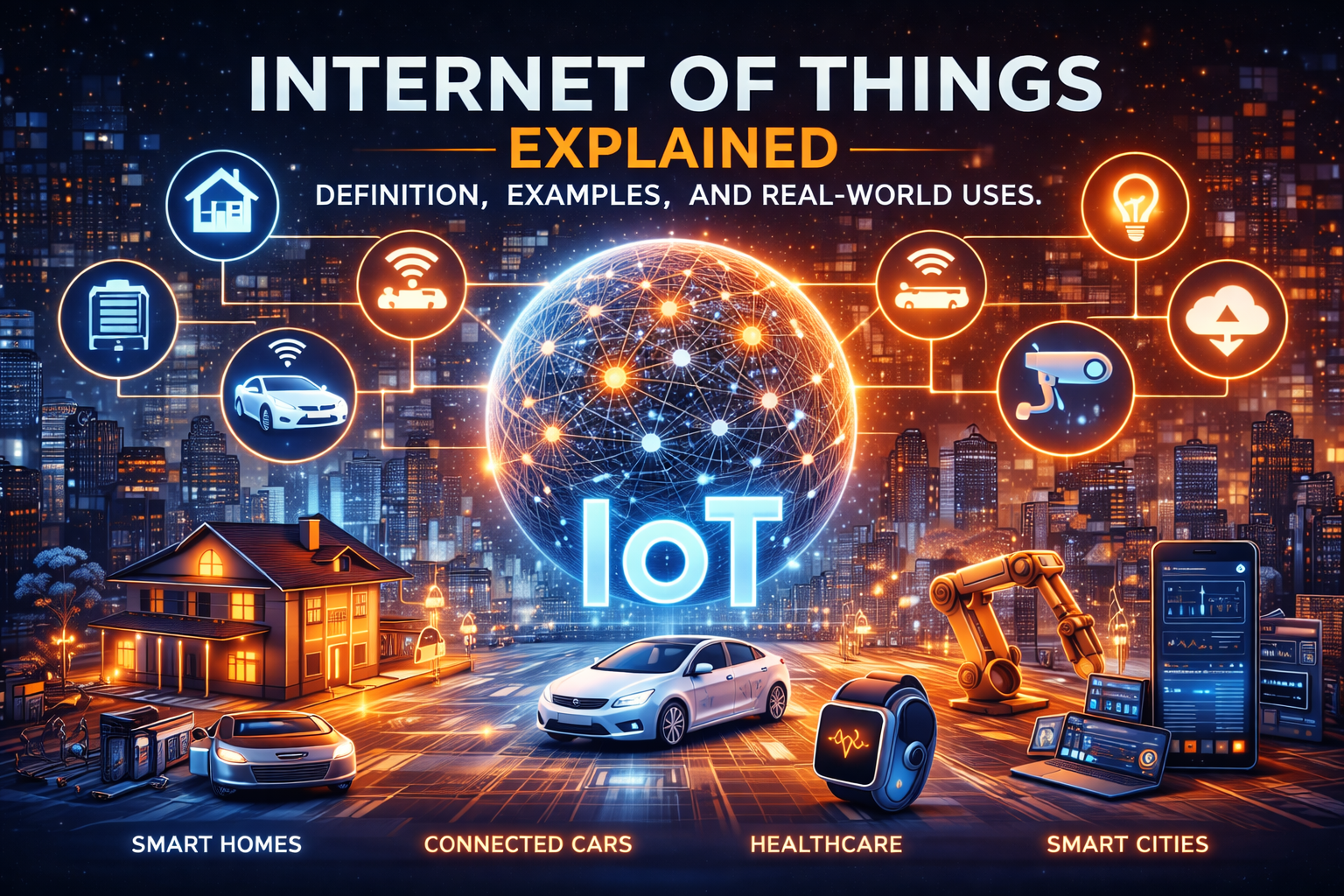
- Real-world internet of things examples span consumer use (smart homes, wearables), enterprise (smart cities, logistics), and industrial applications (IIoT).
- The technology is poised for massive growth, with the number of connected devices projected to more than double by 2030 (Statista — 2024).
Introduction
The Internet of Things (IoT) represents one of the most significant technological shifts since the advent of the World Wide Web. It describes a vast, interconnected ecosystem where physical objects are no longer passive tools but active participants in the digital world, constantly gathering and exchanging information. This revolutionary concept bridges the gap between the physical and digital realities, creating a highly responsive and efficient world.
According to Statista (2024), the global number of connected IoT devices is projected to exceed 29 billion by 2030, a sharp increase from the roughly 13.8 billion devices in 2021. This statistical hook underscores the sheer scale and growth trajectory of this technology. So, what exactly is the internet of things and why is it drawing such massive investment and excitement across every major industry?
The core idea is simple yet profound: take any physical thing—a car, a refrigerator, a machine part, a city traffic light—and give it the ability to sense its environment, process data, and communicate without human intervention. This capability is what drives the modern IoT internet of things revolution.
What is the Internet of Things (IoT)?
To truly understand the landscape, we first need a clear internet of things definition.
Defining the Internet of Things (IoT)
The Internet of Things is a system of interrelated computing devices, mechanical and digital machines, objects, animals, or people that are provided with unique identifiers (UIDs) and the ability to transfer data over a network without requiring human-to-human or human-to-computer interaction. In simpler terms, it’s about machines talking to machines and using the data to automate processes, monitor conditions, and make intelligent decisions.
The term “thing” in IoT is broad. It could be:
- A person with a heart monitor implant.
- A farm animal with a biochip transponder.
- An automobile that has built-in sensors to alert the driver when tire pressure is low.
- Any natural or man-made object that can be assigned an Internet Protocol (IP) address and is able to transfer data over a network.
The Foundational Pillars of IoT
The successful operation of any IoT system relies on four fundamental components working in concert.
- Sensing & Actuation: This is the physical layer. Devices, ranging from simple temperature sensors to complex video cameras, collect data from the environment. Actuators, on the other hand, allow the device to act on the environment (e.g., turning a motor, opening a valve).
- Network Connectivity: The collected data needs a pathway. This layer includes protocols and communication technologies like Wi-Fi, Bluetooth, Zigbee, cellular networks (5G/LTE), and Low-Power Wide-Area Networks (LPWAN) like LoRaWAN. This connects the “things” to the broader network.
- Data Processing & Storage (Cloud/Edge): Raw data from sensors is often massive and requires immediate analysis. This is handled by processing platforms, either in the cloud (for long-term storage and complex analysis) or at the “edge” of the network (for low-latency, real-time decision-making).
- Application Layer: This is the user-facing interface, often a mobile app or dashboard, that translates the processed data into meaningful insights and controls. This is where a homeowner controls their smart thermostat or a factory manager monitors production line efficiency.
The sheer complexity of securely coordinating billions of devices while processing their data in real-time is a non-trivial engineering feat. One of the biggest challenges facing the growth of the IoT is maintaining interoperability across devices from different manufacturers a bit like trying to get a 1990s VCR to talk to a modern streaming stick.
Real-World Internet of Things Examples and Applications
The ubiquity of the Internet of Things means its applications are incredibly diverse, often falling into three main categories: Consumer, Enterprise, and Industrial. Exploring these internet of things examples clearly illustrates the technology’s impact.
Consumer IoT (CIoT): The Smart Home
This is the most visible face of the IoT. CIoT devices are focused on improving daily life, convenience, security, and energy efficiency in the home.
- Smart Thermostats: Devices like Nest activate heating or cooling based on learned user habits, weather patterns, and occupancy sensors, saving energy.
- Voice Assistants: Amazon Echo and Google Home act as central hubs, controlling lights, locks, and media via simple voice commands.
- Wearables: Fitness trackers (like Fitbit) and smartwatches (like Apple Watch) are sophisticated IoT devices, continuously collecting physiological data and activity metrics. They are a classic example of sensing and data transfer.
Enterprise IoT: Smart Cities and Logistics
Enterprise IoT focuses on public infrastructure, large-scale operations, and commercial services.
| Application | IoT “Things” Used | Benefit |
| Smart Cities | Connected street lights, traffic sensors, smart bins | Reduced energy consumption, optimized traffic flow, better waste management. |
| Supply Chain/Logistics | GPS trackers, environmental sensors on cargo containers | Real-time monitoring of goods location, temperature, and humidity; reduced spoilage. |
| Smart Healthcare (IoMT) | Remote patient monitoring (RPM) devices, smart beds | Constant vital sign monitoring for high-risk patients outside the hospital; faster emergency response. |
| Retail | RFID tags, smart shelves, in-store sensors | Real-time inventory tracking, personalized in-store offers, reduced theft. |
Industrial Internet of Things (IIoT): Industry 4.0
The Industrial Internet of Things is often considered the most impactful financially. It connects machines, assets, and control systems in manufacturing, energy, and heavy industry.
Predictive Maintenance
This is a cornerstone of IIoT. Instead of performing scheduled maintenance (which might be too early or too late) or waiting for equipment to fail, sensors on machinery monitor vibration, temperature, and acoustic signatures. This data is analyzed to predict exactly when a component is likely to fail, allowing maintenance to be scheduled just in time. This prevents costly unplanned downtime.
Asset Tracking and Management
In large refineries or mines, locating a specific piece of equipment can be a time-consuming chore. IIoT tags and localized networks allow managers to pinpoint the location of every major asset in real-time, improving operational efficiency and accountability.
A light anecdote: A few years ago, a major auto manufacturer was struggling with bottlenecks on one of its assembly lines. They installed simple proximity sensors (an IoT solution) on their trolleys and tools. They discovered that one highly specialized but seldom-used tool was repeatedly being misplaced for 15–20 minutes per shift, leading to accumulated delays equivalent to losing several vehicles a month. The seemingly minor IoT deployment solved a multi-million dollar problem.
The Challenges and Future of the IoT Internet of Things
While the potential of the Internet of Things is virtually limitless, its widespread adoption is still tempered by significant challenges that industry leaders, including software developers and hardware professionals, are working to overcome.
Security and Privacy Concerns
Perhaps the most pressing concern is security. Every connected “thing” is a potential entry point for a malicious actor. Poorly secured devices can be hijacked, not to spy on the user, but to be recruited into massive botnets that launch crippling attacks against internet infrastructure. This is why standardized security protocols and consumer education are paramount. Furthermore, the sheer volume of personal data collected by wearables and smart home devices raises serious privacy questions about ownership and regulation.
Interoperability and Standardization
As mentioned earlier, the lack of universal standards means that devices from different manufacturers often struggle to communicate seamlessly. This creates siloed systems and complicates the integration of new technologies. The industry is attempting to address this through consortiums and open standards like Matter (for the smart home) and various open-source IoT platforms.
The Rise of Edge Computing
The future of the IoT internet of things is moving computation closer to the “thing” itself. Edge computing involves processing data at the source rather than sending everything to a central cloud. This is essential for:
- Low Latency: Autonomous vehicles, for instance, cannot afford a delay while a decision is sent to the cloud; they need instant, real-time data processing.
- Bandwidth Efficiency: Sending only necessary, filtered data to the cloud saves considerable network bandwidth.
- Privacy: Sensitive data can be processed and scrubbed locally before being transmitted.
Conclusion
The Internet of Things is rapidly evolving from a futuristic concept into a foundational layer of modern society and industry. By connecting our world’s physical assets to the digital realm, the IoT is enabling unprecedented levels of efficiency, automation, and insight from reducing energy waste in our homes to optimizing trillion-dollar supply chains. As technology matures and standardization efforts gain traction, the true potential of the interconnected, intelligent world promised by the internet of things will continue to unfold.
Are you a business owner exploring how smart sensors can optimize your operations, or an engineering student looking to specialize in this growing field? We offer comprehensive consulting and development services to help you design, build, and secure your next-generation IoT internet of things solution. Contact our experts today to start building your smarter future.