
Summary
- Industrial Grit: Build code to survive factory heat and dust, treated like a rugged machine part.
- Seamless Links: Connect old hardware with modern ERPs to keep data flowing from machines to management.
- Virtual Safeguards: Use digital twins to squash bugs before they touch heavy equipment or operators.
- Smart Evolution: Maintain tight version control so tech stays current, not a digital fossil.
- Profit Power: High-quality code slashes downtime, turning your digital transition into a major financial win.
Introduction
According to Statista (2024), the global smart manufacturing market is projected to reach approximately $650 billion by 2029. This massive growth highlights a fundamental shift where steel and grease now share space with silicon and scripts. The Software Development Lifecycle in Manufacturing has become the backbone of this evolution, ensuring that code operates as reliably as the heavy machinery it controls.
Building software for a factory is vastly different from building a social media app. If a mobile app crashes, a user might lose a photo or a few seconds of time. If industrial software fails, an entire production line could grind to a halt, costing thousands of dollars per minute. This reality necessitates a specialized approach to how software is conceived, built, and maintained within the industrial sector.
Effective industrial software lifecycle management requires a deep understanding of both digital logic and physical constraints. It involves a marriage between Information Technology (IT) and Operational Technology (OT). This guide serves as a roadmap for leaders ready to master the manufacturing software development process and lead their organizations into the next era of productivity.
Adapting the Software Development Lifecycle in Manufacturing
Standard software practices often fall short when they encounter the harsh environments of a production plant. Dust, heat, and electromagnetic interference are variables that a developer in a climate-controlled office rarely considers. Therefore, the Software Development Lifecycle in Manufacturing must be more resilient than its counterparts in other industries.
The process begins with a realization that the code is a component of a larger machine. Every line of logic must account for the physical safety of operators and the longevity of hardware. When a team approaches industrial software lifecycle management with a factory-first mindset, they create tools that empower workers rather than frustrate them.
Why does software so frequently fail when it meets the reality of a grease-covered workshop? Usually, it is because the developers failed to account for the unique communication protocols and legacy systems already in place. Successful integration requires a meticulous bridge between modern APIs and decades-old programmable logic controllers (PLCs).
Core Phases of the Manufacturing Software Development Process
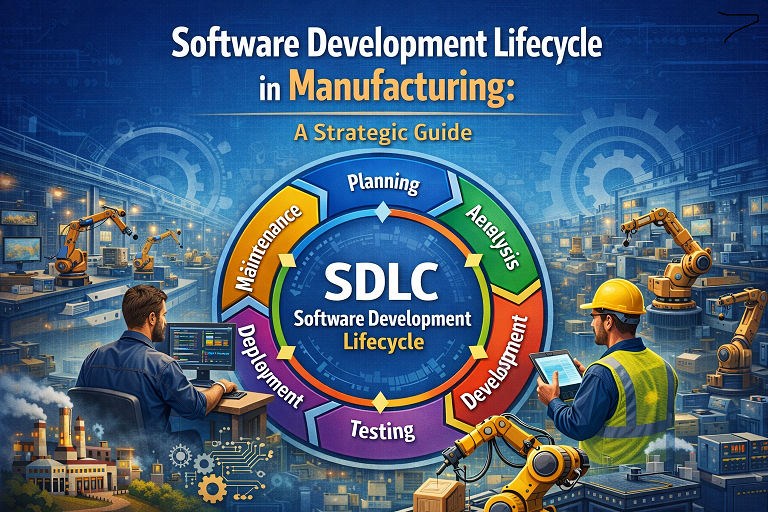
A structured manufacturing software development process follows a logical progression. While Agile methodologies are popular, many industrial projects utilize a hybrid approach to ensure stability.
Requirement Gathering and Analysis
Everything starts with understanding the problem on the floor. Is the goal to reduce waste, increase throughput, or improve safety? During this stage, IT managers and production leaders must speak the same language. This phase defines the functional requirements and ensures the project aligns with the broader goals of digital transformation in manufacturing.
System Design and Architecture
In this step, the team creates the architectural blueprint. This includes deciding how the software will interact with manufacturing ERP and automation systems. The design must be modular, allowing for future updates without requiring a complete system overhaul. Think of it as building a Lego set where pieces can be swapped out as technology advances.
Development and Coding
Coding in a manufacturing context involves more than just standard languages like Python or C#. It often requires familiarity with industrial protocols like Modbus, OPC UA, or MQTT. Developers must write clean, efficient code that minimizes latency. In high-speed production, even a millisecond delay in software response can cause mechanical synchronization issues.
Testing in a Simulated Environment
Testing is perhaps the most critical part of the Software Development Lifecycle in Manufacturing. Before any code goes “live,” it should be run in a digital twin or a hardware-in-the-loop simulation. This allows the team to find bugs without risking expensive machinery or human safety. If a bug exists, it is much better to find it in a simulation than on a 10-ton hydraulic press.
Strategies for Industrial Software Lifecycle Management
Managing software does not end at deployment. In fact, that is simply the end of the beginning. Industrial software lifecycle management involves continuous monitoring and iterative improvements to keep pace with changing market demands.
One effective strategy is the implementation of a robust version control system. In a factory setting, multiple engineers might be tweaking code simultaneously. Without a central “source of truth,” conflicting updates can lead to chaos. Maintaining a clear history of changes allows for quick rollbacks if a new update causes unexpected behavior.
Another pillar is predictive maintenance for code. Much like a machine needs oil, software needs updates to remain secure against evolving cyber threats. Regular audits ensure that the software remains compatible with new hardware and that its performance remains optimal. Ignoring these updates is like ignoring a “check engine” light you have seen since 2012—eventually, something will break.
Optimizing Manufacturing ERP and Automation Systems
The true power of modern software lies in integration. When manufacturing ERP and automation systems communicate seamlessly, the data flow provides unprecedented visibility into the business. An ERP system that knows exactly what is happening on the assembly line can manage inventory and shipping with surgical precision.
Digital transformation in manufacturing is often hindered by “data silos,” where different departments use software that cannot talk to each other. Breaking down these walls requires a unified approach to the Software Development Lifecycle in Manufacturing. By designing software with interoperability in mind, companies can create a cohesive ecosystem where information flows from the warehouse to the boardroom.
Could a small bug in the code lead to a massive bottleneck on the assembly line? Absolutely. That is why integration testing is vital. The software must be tested alongside the ERP and the physical automation hardware to ensure that every handshake between systems is successful.
Overcoming Barriers to Digital Transformation in Manufacturing
The path to a fully digital factory is rarely smooth. Resistance to change is a common hurdle, as veteran staff may be skeptical of new digital tools. To overcome this, the manufacturing software development process should involve end-users early and often. When operators see that software makes their jobs easier, they become champions of the new system.
Budgetary constraints also play a role. However, it is helpful to view software as an investment rather than an expense. According to a McKinsey (2023) report, companies that successfully implement digital manufacturing technologies see a 30-50% reduction in machine downtime. These savings quickly offset the initial costs of development and implementation.
Technical debt is another silent killer. This occurs when teams take shortcuts during development to meet a deadline. Over time, these shortcuts accumulate, making the system fragile and difficult to update. A disciplined Software Development Lifecycle in Manufacturing prioritizes long-term stability over short-term speed, ensuring the system remains an asset for years to come.
Choosing Between Custom and Off-the-Shelf Solutions
A major decision in the manufacturing software development process is whether to build a custom solution or buy a pre-made one. Off-the-shelf software is faster to deploy but often requires the business to change its processes to fit the software. Custom software, on the other hand, is built to fit the unique needs of the factory.
For many, a hybrid approach works best. Companies might use a standard ERP platform but develop custom modules for specific niche processes. This allows them to benefit from the stability of a major platform while maintaining the flexibility of bespoke code. Regardless of the choice, the principles of industrial software lifecycle management remain the same.
Is your current system helping you grow or keeping you stuck in the past? If you find yourself working around your software rather than with it, it may be time to re-evaluate your digital strategy. A well-executed Software Development Lifecycle in Manufacturing ensures your tools evolve alongside your business.
Conclusion
Mastering the Software Development Lifecycle in Manufacturing is no longer optional for companies that wish to remain competitive. By following a structured manufacturing software development process, businesses can reduce risks, improve efficiency, and foster innovation. From the initial requirements to the long-term management of manufacturing ERP and automation systems, every step is an opportunity to strengthen the foundation of your operations. Embracing digital transformation in manufacturing requires patience and a commitment to quality, but the rewards—increased uptime and smarter production are well worth the effort.
Frequently Asked Question
What are the main benefits of a structured SDLC in manufacturing?
A structured approach reduces the risk of system failure and ensures that software is compatible with existing industrial hardware. It helps in managing costs by identifying potential issues early in the design phase rather than during production. Additionally, it provides a clear roadmap for future updates, ensuring the software can grow with the company.
How does Agile differ from Waterfall in a manufacturing context?
Waterfall is a linear approach that is excellent for projects with fixed requirements and hardware constraints. Agile is more iterative, allowing for frequent changes and feedback. Many manufacturing firms use a hybrid model, using Waterfall for the hardware-dependent stages and Agile for the software interface and data analytics portions.
How can I ensure my manufacturing software is secure?
Security must be integrated into every stage of the Software Development Lifecycle in Manufacturing. This includes using encrypted communication protocols, performing regular vulnerability scans, and ensuring that the software is isolated from the public internet where possible. Training staff on cybersecurity best practices is also a vital component of a secure lifecycle.
What is the role of a digital twin in the SDLC?
A digital twin is a virtual representation of a physical asset or process. In the SDLC, it is used to test software in a risk-free environment. This allows developers to see how the code will affect the physical machinery without actually running the machines, preventing accidents and reducing wear and tear on expensive equipment.