
Summary
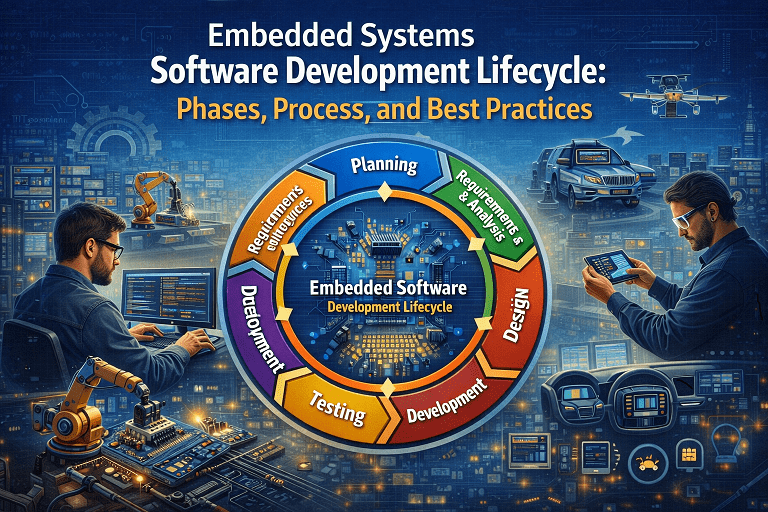
- The Embedded Systems Software Development Lifecycle provides a structured framework for creating reliable firmware and software.
- Key phases include requirement analysis, hardware-software co-design, implementation, and rigorous testing.
- Unlike standard software, embedded lifecycles must account for strict hardware constraints and real-time performance.
- Adopting the V-Model or Agile-Embedded hybrids improves time-to-market and reduces post-release failures.
- Verification and validation remain critical to ensure safety in mission-critical applications like medical devices and automotive systems.
Introduction
According to Statista (2024), the global embedded software market reached a valuation of roughly $21.5 billion, with projections suggesting continued expansion as IoT and automotive sectors expand. This growth emphasizes the necessity for a robust Embedded Systems Software Development Lifecycle to manage the complexity of modern devices. As systems transition from simple microcontrollers to multi-core processors running complex AI algorithms, the traditional “code and pray” method leads to catastrophic hardware failures or expensive recalls.
A structured approach ensures that the software interacts seamlessly with the physical world. This process demands a unique synergy between electronic engineering and computer science, where memory limits and power consumption dictate every line of code. Failure to follow a disciplined path often results in the dreaded “magic smoke” or, worse, a device that fails in the hands of a consumer.
Successful deployment relies on understanding how bits influence atoms. By following a dedicated lifecycle, teams can synchronize hardware availability with software maturity. This guide explores the essential phases and strategies that keep modern embedded projects on track and within budget.
Defining the Embedded Systems Software Development Lifecycle
The lifecycle of embedded software differs from typical application development because of the inextricable link to hardware. While a web developer can ignore the underlying server architecture, an embedded engineer must account for every register and clock cycle. This framework governs the journey from a conceptual flicker to a fully functional, burned-into-silicon reality.
The Hardware-Software Co-design Reality
In this ecosystem, software development cannot happen in a vacuum. Decisions regarding the microcontroller (MCU) or System-on-Chip (SoC) happen simultaneously with software architecture planning. If the hardware team chooses a chip with 32KB of RAM, the software team must refrain from using bloated libraries that require 64KB. This mutual dependency defines the embedded systems SDLC phases, forcing a high degree of collaboration between disciplines.
Why a Specialized Lifecycle Matters
Standard software models often assume infinite resources or easy updates. Embedded systems frequently live in remote locations or safety-critical environments where a “hotfix” is impossible. A specialized lifecycle prioritizes reliability and resource management. It provides a roadmap to handle the constraints of real-time operating systems (RTOS) and peripheral interfaces that standard SDLCs overlook.
Essential Embedded Systems SDLC Phases
A disciplined process moves through distinct stages to minimize risk. Each phase serves as a gate, ensuring that errors in logic or hardware interfacing are caught before they become permanent fixtures in the hardware.
Requirement Gathering and Analysis
Before a single line of C code exists, engineers must define what the device shall do. This involves functional requirements (e.g., “the motor must spin at 500 RPM”) and non-functional requirements (e.g., “the battery must last three years”). Clear documentation prevents scope creep and ensures the final product meets the user’s actual needs.
System Design and Architecture
During this phase, the team selects the RTOS, defines communication protocols (I2C, SPI, CAN), and creates the memory map. The architecture acts as the skeleton for the entire project. A poor design here creates bottlenecks that no amount of code optimization can fix later.
Implementation and Coding
This is where the firmware development lifecycle enters the heavy lifting stage. Developers write drivers, middleware, and application logic. Unlike high-level programming, this stage involves heavy use of debugging tools like JTAG/SWD and logic analyzers. Code must be lean, efficient, and often follows standards like MISRA C to ensure safety.
Verification and Validation
Embedded software verification and validation ensures the software meets specifications and functions correctly in the target environment. Verification asks, “Did we build the product right?” while validation asks, “Did we build the right product?” This phase involves unit testing, integration testing, and system-level checks.
Common Methodologies in the Embedded Software Development Process
Choosing the right path depends on the project’s risk profile and the certainty of its requirements. While some prefer the rigid safety of the V-Model, others move toward the flexibility of Agile.
The Traditional V-Model
The V-Model remains a staple in embedded engineering, especially in regulated industries. It pairs every development phase with a corresponding testing phase. This symmetry ensures that for every design decision, a test case exists to prove its success. It is highly predictable but lacks the flexibility to handle sudden changes in hardware components.
Agile-Embedded Hybrid
Agile is difficult in embedded systems because you cannot “sprint” your way into a new physical PCB. However, many teams use a hybrid approach. They use Agile for software features while maintaining a Waterfall structure for hardware. This allows for frequent iterations on the logic while respecting the longer lead times of physical manufacturing.
Prototyping and Simulation
Modern teams use digital twins or hardware-in-the-loop (HIL) simulators to begin the embedded software development process before the physical boards arrive. This parallelism saves months of time and allows for early bug detection in the logic layer.
Deep Dive into Embedded Software Verification and Validation
Testing in the embedded world is a multi-layered discipline. It moves from the isolation of a single function to the chaotic reality of a fully assembled device interacting with its environment.
Unit and Integration Testing
Unit tests check individual blocks of code, often on a host PC using a compiler like GCC. Integration testing then checks how these blocks interact. For example, does the sensor driver correctly pass data to the filtering algorithm? These tests are the first line of defense against logic errors.
Hardware-in-the-Loop (HIL) Testing
HIL testing involves connecting the embedded controller to a simulation system that mimics the real-world sensors and actuators. According to a report by IEEE (2023), HIL testing can reduce the cost of finding bugs by up to 10 times compared to testing on final hardware. It allows for testing dangerous scenarios—like a car’s engine overheating—without actually destroying expensive prototypes.
System-Level Validation
The final step involves the embedded system design and testing lifecycle coming together. The device is tested in its actual environment, facing real-world noise, temperature fluctuations, and user errors. This ensures the product is robust enough to survive outside the lab.
Best Practices for a Robust Lifecycle
To avoid the common pitfalls of firmware development, engineers should adopt industry-proven strategies that emphasize clarity and consistency.
- Version Control for Everything: Never limit versioning to code. Hardware schematics, datasheets, and compiler versions should stay tracked to ensure reproducibility.
- Automated Testing Pipelines: Use CI/CD tools to run tests every time a developer commits code. This catches regressions before they bury themselves deep in the codebase.
- Strict Coding Standards: Adopt standards like MISRA C:2012 or CERT C. These sets of rules exclude “dangerous” language features that lead to unpredictable behavior.
- Power Awareness: In battery-operated devices, treat power as a finite resource. Use profiling tools to see which functions drain the most energy.
- Documentation as Code: Keep your technical manuals and API descriptions in the same repository as the source code to prevent them from becoming obsolete.
Challenges in Modern Firmware Development
As we move toward 2026, the complexity of these systems continues to rise. Security is no longer an afterthought. With the rise of the Mirai botnet and subsequent IoT attacks, developers must integrate security into every phase of the lifecycle.
One might wonder if the added overhead of a strict lifecycle slows down innovation. On the contrary, a clear framework allows for faster movement by reducing the time spent on “firefighting” bugs later. The hardware-software barrier is also thinning, as FPGA-based designs allow for reconfigurable logic, making the firmware development lifecycle even more dynamic.
There is a running joke in the industry that an embedded engineer’s favorite phrase is “it’s a hardware issue,” while the hardware engineer insists “it’s a software bug.” A well-defined lifecycle acts as the mediator in this eternal dispute, providing clear traces and data to identify the true source of an error.
Conclusion
Navigating the Embedded Systems Software Development Lifecycle requires a balance of rigid engineering discipline and creative problem-solving. By understanding the specific requirements of hardware-software co-design and implementing a structured verification process, developers can create devices that are both innovative and incredibly reliable. Whether you use the traditional V-Model or a modern Agile hybrid, the goal remains the same: high-quality code that lives harmoniously within its physical shell. As the world becomes increasingly automated, mastering this lifecycle is the only way to ensure the machines we rely on continue to function as intended.
Frequently Asked Questions
1. How does the embedded SDLC differ from web development SDLC?
Embedded lifecycles are constrained by physical hardware and real-time requirements. While web apps can scale resources dynamically, embedded software must operate within fixed memory, CPU, and power limits. Furthermore, updating embedded software (OTA) is more complex and carries higher risks of “bricking” the device.
2. What is the most critical phase in the firmware development lifecycle?
While every phase is important, Requirement Analysis is often considered the most critical. Errors made here propagate through the entire project. If the power consumption requirement is misunderstood, the chosen hardware might fail to meet the battery life goals, necessitating a complete redesign.
3. Why is verification and validation so emphasized in embedded systems?
Embedded devices often control physical systems, such as brakes, pacemakers, or industrial kilns. A software failure can lead to physical damage or loss of life. Therefore, embedded software verification and validation includes rigorous stress testing and corner-case analysis that standard software rarely undergoes.
4. Can Agile truly work for embedded systems?
Yes, but it requires adaptation. Teams use Hardware Abstraction Layers (HAL) to develop software independently of the physical PCB. They also rely on simulation tools and “dev-boards” to mimic the final hardware during early sprints, allowing for iterative progress even while the final hardware is in production.