
Summary
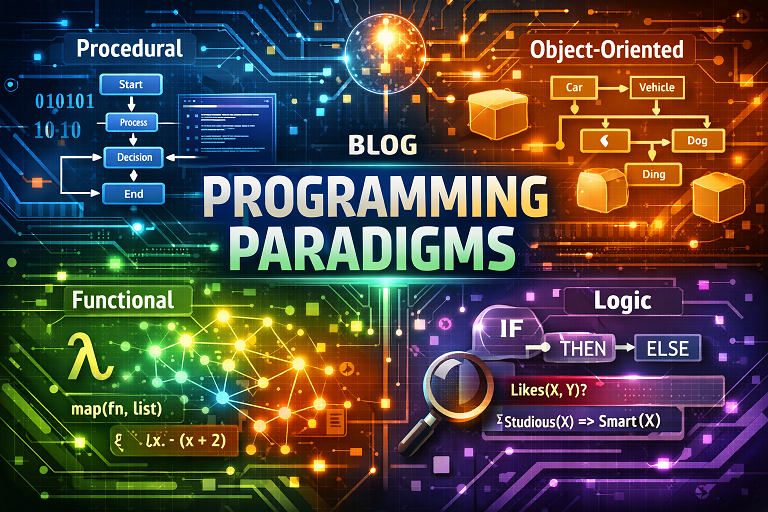
- Programming paradigms function as the fundamental blueprints or philosophies that guide how developers structure and organize code.
- Understanding these frameworks helps developers choose the right tool for specific software engineering challenges.
- The four primary categories discussed include procedural, object-oriented, functional, and declarative styles.
- Modern development frequently adopts a multi-paradigm approach, blending different styles to create robust, scalable applications.
- This guide provides a foundational overview for students and professionals preparing for technical interviews or new projects.
Introduction to programming paradigms
According to the Stack Overflow 2024 Developer Survey, approximately 75% of professional developers work with multiple programming languages, most of which support more than one structural philosophy. This versatility highlights why an introduction to programming paradigms is a vital milestone for any aspiring software creator. Rather than focusing on syntax, these paradigms represent the high-level strategies used to solve complex digital problems.
A paradigm serves as a lens through which a programmer views the world. Some see a series of steps, while others view a collection of interacting entities. Choosing a specific approach influences how data flows, how state is managed, and how easily a system can grow over time.
Learning these concepts early prevents the common mistake of trying to hammer every problem with the same tool. It provides a roadmap for understanding why C++ feels different from Haskell or why SQL seems so unique compared to Java.
Defining Programming Paradigms
A programming paradigm is essentially a classification or style of programming. It provides a methodology for organizing logic and defining how a computer should perform tasks. Most languages are not limited to a single style; instead, they allow developers to mix and match strategies depending on the goal.
The Two Main Branches
At the highest level, most coding styles fall into two broad buckets: imperative and declarative.
- Imperative Programming: This style focuses on how to achieve a result. It involves writing explicit, step-by-step instructions that change the state of the program.
- Declarative Programming: This approach focuses on what the desired outcome is, leaving the specific implementation details to the underlying system or compiler.
Why These Categories Matter
Categorizing languages this way allows developers to predict how a language will behave. If a developer knows a language follows a functional style, they can expect heavy use of mathematical functions and immutable data. This mental shorthand simplifies the learning curve for new technologies.
The Procedural Programming Paradigm
The procedural programming paradigm is perhaps the most intuitive for beginners. It treats a program as a linear sequence of instructions or a “to-do list” for the computer. This style relies heavily on procedures, also known as routines or functions, to perform specific tasks.
Key Characteristics and Flow
In a procedural environment, the program moves from the top of the file to the bottom, jumping into functions when called and returning once the task concludes. This structure mirrors how a person might follow a recipe: crack the eggs, whisk the batter, and bake.
- Top-down approach: The logic is broken into smaller, manageable chunks.
- Global data: Information is often stored in a way that multiple functions can access it.
- Sequential execution: Commands run in a predictable, linear order.
Common Examples and Use Cases
C and Pascal are classic examples of this style. Developers frequently use this approach for system-level programming or simple scripts where the overhead of more complex structures is unnecessary. While it is efficient for small tasks, maintaining a massive procedural codebase can become difficult as the number of global variables grows.
The Object Oriented Programming Paradigm
The object oriented programming paradigm (OOP) changed the landscape of software development by organizing code around data, or “objects,” rather than logic. If procedural programming is a recipe, OOP is like building a car from modular parts like engines, tires, and steering wheels.
The Four Pillars of OOP
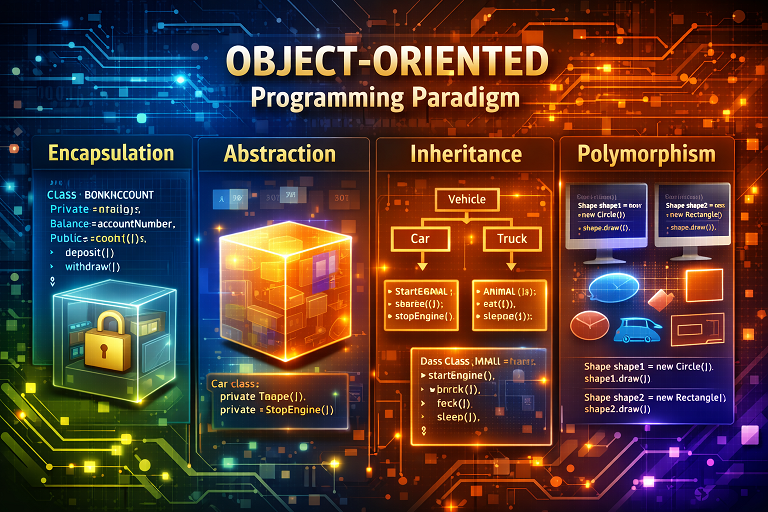
To understand OOP, one must grasp its four fundamental principles:
- Encapsulation: Grouping data and the methods that operate on that data into a single unit (an object).
- Abstraction: Hiding complex implementation details and showing the user merely the essential features.
- Inheritance: Creating new classes based on existing ones to reuse code.
- Polymorphism: Allowing different objects to respond to the same command in their own unique way.
Real-World Applications
Java, Python, and C# are heavy hitters in this space. Most enterprise software from banking systems to mobile apps relies on OOP because it makes large-scale projects easier to manage and debug. By breaking a system into independent objects, teams can work on different parts of the code without stepping on each other’s toes.
The Functional Programming Paradigm
The functional programming paradigm views computation as the evaluation of mathematical functions. It avoids changing state and mutable data, which can lead to fewer bugs in complex systems. This style is currently seeing a massive resurgence in data science and high-concurrency environments.
Immutability and Pure Functions
Two concepts define this paradigm:
- Pure Functions: A function that, given the same input, will always return the same output and has no side effects (like modifying a global variable).
- Immutability: Once data is created, it cannot be altered. Instead of changing a list, a functional programmer creates a new list with the desired changes.
Why It Is Gaining Popularity
Languages like Haskell, Erlang, and even modern versions of JavaScript embrace functional concepts. According to a Gartner (2023) report on software architecture trends, functional styles are preferred for distributed systems because they eliminate the “race conditions” that occur when multiple processes try to change the same data simultaneously.
The Declarative Programming Paradigm
The declarative programming paradigm is the “hands-off” approach to coding. Instead of telling the computer every single step, the programmer describes the final state.
Logic and Database Languages
SQL (Structured Query Language) is the most famous declarative example. When a developer writes SELECT * FROM Users WHERE Age > 21, they are not telling the database how to scan the hard drive or which algorithm to use. They are simply stating what data they want.
HTML and CSS as Declarative Tools
Web development relies heavily on this style. HTML declares the structure of a page, and CSS declares how it should look. Neither language explains the low-level rendering logic; the browser handles those details. This separation of “what” and “how” makes development significantly faster for specific domains.
The Role of Paradigms in Modern Software Engineering
In the professional world, understanding these concepts is more than an academic exercise. It is a core competency that differentiates a junior coder from a senior architect. As projects move through the Software Development phases, the choice of paradigm impacts everything from the initial design to long-term maintenance.
For instance, during the design phase of the SDLC, an architect must decide if the system requires the strict data modeling of OOP or the stateless efficiency of a functional approach. Making the wrong choice here can lead to technical debt that haunts a project for years.
Multi-Paradigm Languages
Is there a “best” paradigm? In short: no. Most modern languages are “multi-paradigm.” Python, for instance, allows a developer to write procedural code for a quick script, use OOP for a web framework, and apply functional techniques like map and filter for data analysis.
H4: Factors Influencing Paradigm Choice
When deciding which style to prioritize, consider the following:
- Team Experience: If the team is well-versed in Java, sticking to OOP is usually safer.
- Project Scale: OOP excels at large, modular systems, while procedural is great for tiny utilities.
- Performance Needs: Procedural code often has less overhead, which is why it remains dominant in game engine cores.
Rhetorical question: Why limit oneself to a single tool when the entire workshop is available? Integrating different programming paradigms examples into a single project is now standard practice. This hybrid approach allows developers to use declarative SQL for data fetching, OOP for business logic, and functional patterns for processing that data.
Conclusion
Mastering the introduction to programming paradigms is a journey from being a coder who writes lines of text to an architect who designs systems. By understanding the philosophies of procedural, object-oriented, functional, and declarative styles, you gain the ability to choose the most efficient path for any digital challenge. Whether you are preparing for a technical interview or building the next great app, these frameworks provide the essential structure for success.
Frequently Asked Questions
Can a language belong to more than one paradigm?
Yes, most popular modern languages are multi-paradigm. JavaScript, for instance, supports procedural, object-oriented (via prototypes), and functional programming. This allows developers to use the style that best fits a specific part of their application.
Which paradigm is the easiest for a beginner to learn?
Most beginners find the procedural paradigm easiest to grasp because it follows a logical, step-by-step progression similar to how humans follow instructions. However, many introductory courses start with Python or Java, which introduce OOP concepts very early.
Why is functional programming becoming more popular now?
As hardware moves toward multi-core processors, the functional paradigm’s emphasis on immutability and pure functions makes it easier to write code that runs in parallel. This reduces bugs related to shared state, which is a major headache in modern, high-speed computing.
Do I need to master all of them to get a job?
You should have a strong grasp of at least one (usually OOP or Procedural) and a conceptual understanding of the others. Most entry-level interviews focus on your ability to solve problems using a language you know well, but being able to discuss different paradigms shows a deeper level of computer science maturity.