

Summary
- Market Opportunity: The global mobile app market is projected to exceed $289 billion in 2025, offering immense potential for businesses and startups.
- Development Paths: Choosing between native (iOS/Android) and cross-platform (Flutter/React Native) development is the first critical technical decision.
- Lifecycle Essentials: Successful apps require a rigorous process: discovery, UI/UX design, coding, testing, and post-launch maintenance.
- Emerging Tech: AI, AR, and cloud integration are no longer optional add-ons but core expectations for modern mobile users.
Introduction
The numbers are staggering. According to Precedence Research (2024), the global mobile application market is estimated to reach over $289 billion in 2025 and is on track to cross the $1 trillion mark by 2034. For business owners and startup founders, this isn’t just a trend; it’s a megaphone announcing that the world has moved almost entirely to the small screen.
Whether you are looking to develop mobile apps for industrial automation or the next big consumer hit, the barrier to entry has never been lower, yet the bar for quality has never been higher. Mobile app development is no longer about slapping some code together and hoping for downloads. It requires a blend of engineering precision, user-centric design, and strategic foresight.
This guide walks you through the actual process of building an app from the back-of-the-napkin idea to the final push to the App Store. We will break down the jargon, compare development paths, and explain exactly what your development team does behind the scenes.
The Mobile Landscape: Why Build Now?
Users are glued to their devices. Recent data from Sensor Tower (2024) indicates that the average smartphone user spends roughly 3.5 hours per day in apps. That is a massive window of engagement for businesses to connect with customers, streamline operations, or sell products.
But the “why” goes beyond screen time. Modern apps are becoming the central nervous system for enterprise operations. From factory floor controllers (a niche where specialized mobile app developers thrive) to e-commerce platforms, apps offer real-time data access that web browsers often cannot match in performance or offline capability.
Key Market Drivers
- Ubiquity: 6.8 billion smartphone users globally means your audience is already there.
- Hardware Power: Modern phones have processors rivaling laptops, allowing for heavy-duty tasks like AI processing and complex 3D rendering.
- Connectivity: 5G networks enable instant data transfer, making real-time collaboration and streaming seamless.
Choosing Your Path: Native vs. Cross-Platform
Before writing a single line of code, you must decide how to build. This is usually the first question a mobile app developer will ask you. There are two primary schools of thought, and the right choice depends on your budget, timeline, and performance needs.
Native App Development
Native development involves writing separate codebases for iOS (using Swift or Objective-C) and Android (using Kotlin or Java).
- Pros: Unmatched performance; full access to device hardware (camera, GPS, accelerometer); superior UI fluidity.
- Cons: Higher cost (you effectively build two apps); longer development time.
- Best for: High-performance games, AR/VR apps, or complex industrial tools requiring deep hardware integration.
Cross-Platform Development
Cross-platform frameworks like React Native and Flutter allow mobile app developers to write code once and deploy it to both iOS and Android.
- Pros: Lower cost (one codebase); faster time-to-market; consistent look and feel across devices.
- Cons: Slightly lower performance for graphics-heavy tasks; might lag behind latest OS feature updates.
- Best for: E-commerce, enterprise dashboards, social networking, and most B2B applications.
Note: Many massive companies, including Airbnb and Shopify, have heavily utilized cross-platform technologies to streamline their engineering efforts without sacrificing much in the way of user experience.
The Development Lifecycle
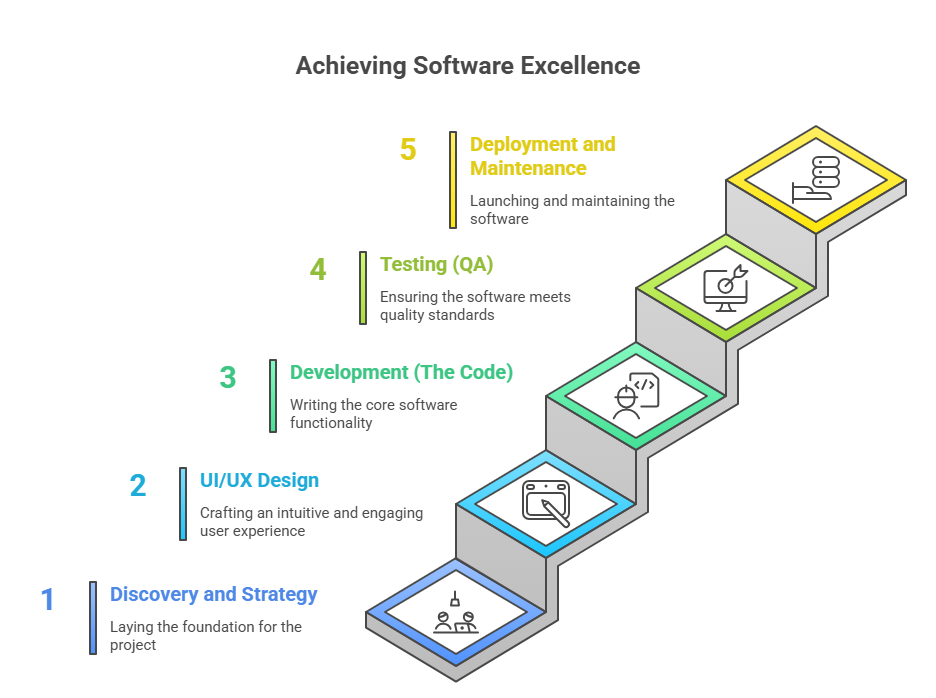
Building software is a science. Professional mobile app developers follow a structured Software Development Life Cycle (SDLC) to ensure the final product is stable and scalable.
1. Discovery and Strategy
This phase is pure research. Who is the audience? What problem does the app solve? You define the Minimum Viable Product (MVP)—the simplest version of your app that still delivers value. Skipping this stage often leads to “feature creep,” where the project bloats with unnecessary tools that delay the launch.
2. UI/UX Design
Design is not decorating; it is architecture. Designers create wireframes (skeletal blueprints) and prototypes (clickable mockups) to test the user flow. If a user has to click five times to do a task that should take one click, the design has failed.
3. Development (The Code)
Here, the heavy lifting happens. This phase is usually split into two parts:
- Frontend: The visual elements users interact with.
- Backend: The server-side logic, databases, and APIs that power the app.
For example, when you book a ride on a rideshare app, the frontend shows the map, but the backend calculates the fare, finds the driver, and processes the payment.
4. Testing (QA)
Quality Assurance (QA) engineers try to break the app. They test for:
- Functionality: Does the login work? Does the cart update?
- Usability: Is the text readable? Are buttons easy to tap?
- Performance: Does the app crash when 1,000 users log in at once?
- Device Compatibility: Does it look good on an old Android phone and the newest iPhone?
5. Deployment and Maintenance
Launching involves submitting the app to the Apple App Store and Google Play Store. Both have strict review guidelines. Once live, the work continues. App development mobile teams must patch bugs, update libraries, and add features based on user feedback.
Essential Tech Stack Components
You don’t need to be an engineer to understand the basic tools your team uses. Knowing these terms helps you communicate better with your iOS mobile app development or Android partners.
- IDEs (Integrated Development Environments): The software used to write code. Android Studio for Android; Xcode for iOS.
- Backend Services: Solutions like AWS, Google Cloud, or Firebase that host your data.
- APIs (Application Programming Interfaces): Connectors that allow your app to talk to other services (e.g., using the Google Maps API to show a location or Stripe API for payments).
Emerging Trends in Mobile Tech
The industry moves fast. Features that were considered “cutting edge” five years ago are now standard. To stay competitive, consider these integrations.
Artificial Intelligence (AI) and Machine Learning
AI is no longer sci-fi. It is the predictive text in your messaging app and the recommendation engine in your streaming service. For business apps, AI can analyze data patterns to predict equipment failure (predictive maintenance) or automate customer service via intelligent chatbots.
Internet of Things (IoT) Integration
Apps are increasingly acting as remote controls for the physical world., mobile apps interface with machinery to monitor pressure, temperature, and output in real-time. This requires specialized knowledge of protocols like MQTT and Bluetooth Low Energy (BLE).
Monetization Strategies
How does the app make money? If you aren’t building an internal enterprise tool, you need a revenue model.
- Freemium: Free to download, but premium features are locked behind a paywall.
- In-App Purchases: Selling virtual goods or services directly within the app.
- Subscription: Recurring revenue model (SaaS), ideal for content or productivity apps.
- Ads: Free for users, paid for by advertisers. (Warning: excessive ads are a top reason for uninstalls).
According to Statista (2024), subscription-based models are seeing the highest growth in consumer spend, particularly in non-gaming sectors like health and productivity.
Hiring the Right Team
Finding the right talent is arguably the hardest part. You have three main options:
- Freelancers: Good for small, simple tasks. High risk of flakiness.
- In-house Team: Total control, but very expensive (salaries, benefits, hardware).
- Development Agency: A balanced choice. You get a full team (PM, designers, devs, QA) for a set contract.
When vetting mobile app developers, look at their portfolio. Have they built apps similar to yours? Do they understand your industry? If you are in semiconductors or manufacturing, a developer who only builds social media clones might not grasp your rigorous data requirements.
The Cost Factor
Cost varies wildly. A simple task-list app might cost $10,000, while a complex secure banking app or an IoT controller could range from $100,000 to $500,000+. Remember, you are paying for the logic and reliability, not the icon on the screen.
Conclusion
Building a mobile application is an investment in digital infrastructure. It requires navigating a complex maze of operating systems, design principles, and coding languages. However, with the right strategy and a skilled team, the result is a powerful asset that lives in your customer’s pocket or your employee’s hand.
Whether you choose native performance or cross-platform flexibility, the goal remains the same: solving a problem with elegance and speed.
Frequently Asked Questions
Q: How long does it take to develop a mobile app?
A: A simple app with basic features typically takes 3 to 4 months. Complex enterprise apps with backend integration, custom design, and extensive testing can take 6 to 9 months or longer. It heavily depends on the scope of your MVP.
Q: Should I build for iOS or Android first?
A: In the US, iOS users often spend more on apps, making it a common “first choice” for consumer startups. However, Android has a larger global market share. Using cross-platform tools like Flutter or React Native allows you to launch on both simultaneously, which is often the best strategy for modern businesses.
Q: How much does it cost to maintain an app after launch?
A: Expect to spend 15% to 20% of the initial development cost annually on maintenance. This covers OS updates (like iOS 18 or Android 15 changes), server hosting costs, bug fixes, and security patches.
Q: What is the most important security measure for a mobile app?
A: Data encryption is critical. You must encrypt data both in transit (using HTTPS) and at rest (using secure device storage like Keychain/Keystore). Also, implement strong authentication (ideally multi-factor) and never hardcode sensitive keys directly into the app’s source code.
Q: How do I measure the success of my app after it launches?
A: Focus on user behavior KPIs, not just downloads. Key metrics include Retention Rate (users who return after 7/30 days), Monthly Active Users (MAU), and the Conversion Rate for your primary goal (e.g., purchase or subscription). High retention indicates real value.