
Introduction
Picture this: A massive water treatment plant suddenly goes offline at 2 AM because a pump failed without warning. Engineers scramble. Thousands of gallons of water sit unprocessed. Repair crews are called in on emergency rates. The cost? Hundreds of thousands of dollars — all from a pump that nobody saw coming.
This scenario plays out in factories, oil refineries, power plants, and municipal facilities every single day. Industrial pumps are the heartbeat of most operations, and when they fail unexpectedly, everything stops.
That’s exactly why pump predictive maintenance is no longer a luxury — it’s a necessity. With the rise of IoT pump monitoring systems and AI-driven diagnostics, engineers now have the tools to “listen” to their pumps 24/7, catch problems early, and act before failure strikes.
This post breaks down exactly how this technology works, why it matters, and what the future looks like for industrial pump health management.
What Is Pump Predictive Maintenance?
Predictive maintenance is pretty much what it sounds like — maintaining equipment before it breaks, based on actual data rather than guesswork or fixed schedules.
Traditional approaches either wait for failure (reactive maintenance) or follow a calendar-based routine (preventive maintenance). Both have serious flaws. Reactive maintenance is expensive and disruptive. Preventive maintenance wastes time and money replacing parts that still have plenty of life left.
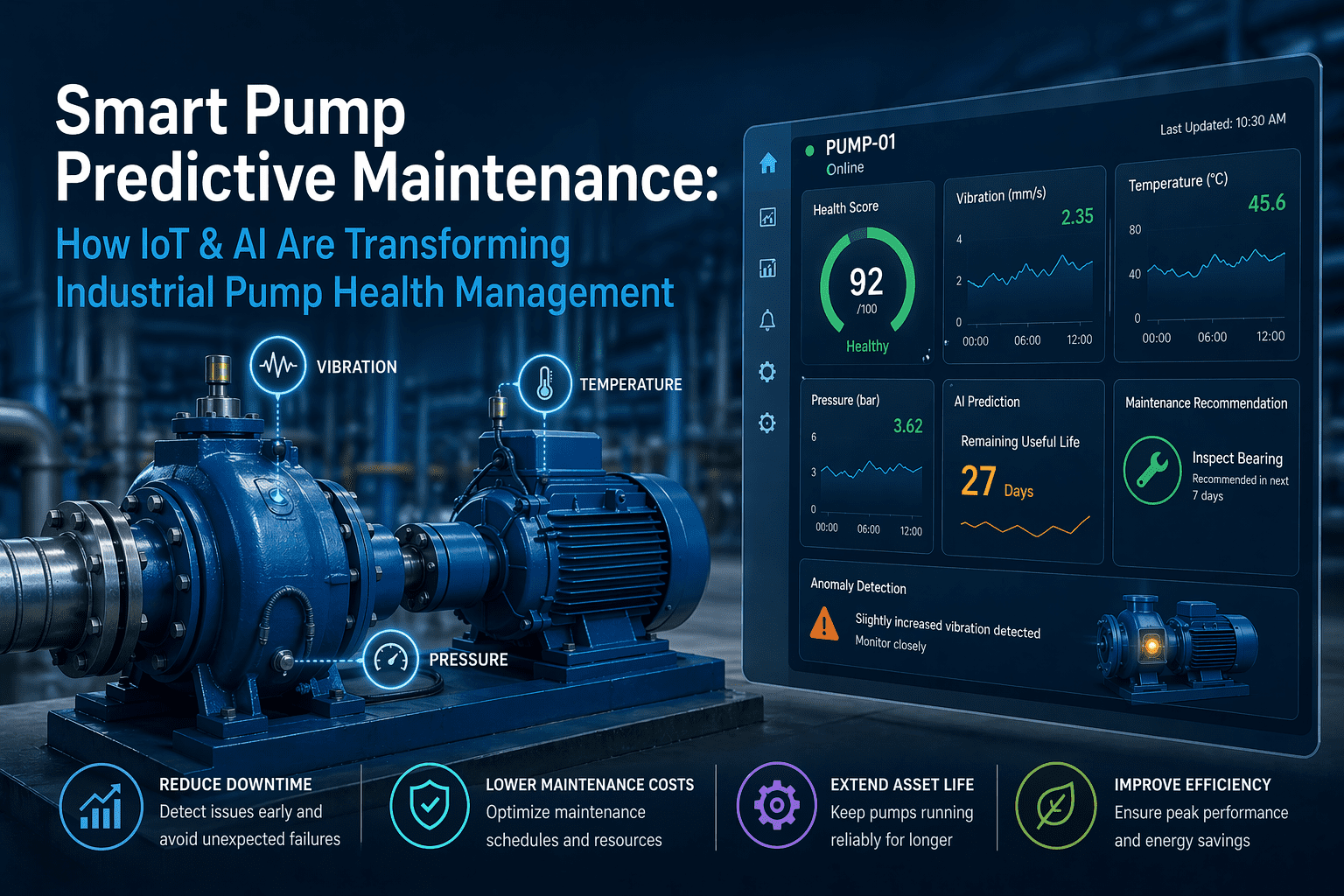
Pump predictive maintenance takes a smarter middle path. Sensors collect real-time data from pumps — vibration, temperature, pressure, flow rate, and more. That data gets analyzed continuously. When something starts to look off, the system flags it early so teams can schedule a repair at a convenient time, using exactly the parts needed.
Think of it like a health check-up, but instead of once a year at the doctor’s office, your pump gets one every second of every day.
The Role of IoT in Pump Monitoring
The Internet of Things (IoT) is what makes all of this possible at scale. IoT pump monitoring systems consist of small, rugged sensors attached to pumps and connected to a central platform via wired or wireless networks.
Here’s what a typical setup looks like:
- Sensors installed on pump bearings, motor casing, inlet/outlet pipes, and control panels
- Edge computing devices that process raw data locally before sending it to the cloud
- Cloud-based dashboards where engineers view real-time pump condition data from anywhere in the world
- Alert systems that notify maintenance teams via SMS, email, or app notifications
The real game-changer is remote pump condition monitoring. A plant manager in Mumbai can check on a pump running in a facility in Surat — from a phone. If a bearing starts running hot at 3 AM, the system sends an alert before anyone even arrives at the plant.
This kind of visibility was simply impossible a decade ago. Today, it’s becoming standard practice in smart factories and industrial operations worldwide.
How AI Improves Pump Diagnostics
Raw data alone isn’t enough. A pump might generate thousands of data points per minute. No human team can review all of that in real time. That’s where AI steps in.
AI-driven pump diagnostics use machine learning models trained on historical pump data — both healthy operation patterns and failure signatures. Once trained, these models can:
- Detect subtle anomalies that human eyes would miss
- Predict failures days or even weeks in advance
- Identify the root cause of a problem, not just the symptom
- Learn over time, getting smarter with every data point
For example, an AI model might notice that a centrifugal pump’s vibration signature is beginning to resemble patterns that preceded a bearing failure in similar pumps six months ago. It flags the pump for inspection — long before anyone would have noticed manually.
Predictive analytics for rotating machinery like this dramatically reduces false alarms too. Older rule-based alert systems would trigger on any slight deviation from normal. AI models understand context, which means fewer unnecessary work orders and more accurate predictions.
Key Technologies Driving the Change
Modern industrial pump health management relies on several complementary technologies working together.
Pump Vibration Analysis Software
Vibration is one of the earliest and most reliable indicators of pump trouble. Misalignment, imbalance, bearing wear, and cavitation all produce distinct vibration frequencies.
Pump vibration analysis software uses accelerometers mounted on the pump casing to capture these signals, then applies Fast Fourier Transform (FFT) analysis to break them down into frequency components. By comparing current patterns against known fault signatures, the software can pinpoint issues with remarkable precision.
Motor Current Signature Analysis (MCSA) for Pumps
You don’t always need to add external sensors. Motor Current Signature Analysis (MCSA) for pumps works by analyzing the electrical current drawn by the pump motor. Mechanical faults — like a broken impeller vane or worn bearing — show up as specific frequency patterns in the motor current.
MCSA is especially valuable in harsh environments where mounting vibration sensors directly on equipment is difficult or dangerous.
Ultrasonic Leak Detection for Pumps
Leaks don’t wait until they’re visible. Ultrasonic leak detection for pumps uses high-frequency acoustic sensors to pick up the ultrasonic sounds that pressurized fluids make when escaping through small gaps or cracks — sounds completely inaudible to the human ear.
This technology allows maintenance teams to find and fix leaks early, preventing environmental contamination, efficiency losses, and downstream equipment damage.
Continuous Bearing Temperature Monitoring
Bearings are among the most failure-prone components in any pump system. Continuous bearing temperature monitoring using thermocouples or infrared sensors tracks temperature trends over time.
A slow, steady rise in bearing temperature — even within “acceptable” limits — can signal inadequate lubrication, excessive load, or early wear. Catching this trend weeks in advance is the difference between a planned bearing swap and an unplanned shutdown.
Pump Cavitation Detection Using AI
Cavitation — when vapor bubbles form inside a pump due to low pressure and then collapse violently — is one of the most destructive phenomena an industrial pump can experience. Left unchecked, it causes rapid impeller erosion and shortens pump life dramatically.
Pump cavitation detection AI analyzes acoustic emissions and vibration patterns to identify cavitation events in real time, often distinguishing between mild and severe cavitation so operators can respond appropriately.
Real-Time Pump Efficiency Tracking
A pump that’s technically “working” might still be costing you more than it should. Real-time pump efficiency tracking compares actual flow, head, and power consumption against the pump’s design curve to calculate how efficiently it’s operating.
Efficiency degradation is often the first sign of wear — and catching it early can save significant energy costs before any mechanical failure occurs.
Benefits of Predictive Maintenance for Industrial Pumps
The case for investing in smart pump health management is strong. Here’s what organizations typically see:
- Reduced unplanned downtime — studies suggest predictive maintenance can cut unexpected failures by up to 70%
- Lower maintenance costs — fixing the right thing at the right time is far cheaper than emergency repairs
- Extended pump lifespan — pumps that are monitored and maintained proactively last significantly longer
- Improved safety — early detection of leaks, overheating, and mechanical stress reduces the risk of accidents
- Energy savings — catching efficiency losses early means lower electricity bills
- Better maintenance scheduling — teams can plan work during scheduled downtime instead of scrambling during production hours
- Regulatory compliance — continuous monitoring creates detailed records that support safety and environmental audits
Real-World Applications and Case Study
Oil & Gas: Offshore platforms use IoT-connected pump monitoring to track dozens of high-pressure pumps remotely. Technicians receive alerts about developing faults and can coordinate repairs during planned maintenance windows, avoiding costly platform shutdowns.
Water & Wastewater: A municipal water authority in Germany deployed remote condition monitoring across 200+ pump stations. Within the first year, they reduced emergency callouts by 60% and cut overall maintenance costs by nearly a third.
Manufacturing: A large automotive parts manufacturer implemented AI-driven pump diagnostics on their coolant circulation pumps. The AI caught early-stage bearing wear in two pumps, allowing planned replacements during a weekend shutdown — avoiding what would have been a multi-day production halt.
Pharmaceuticals: Strict hygiene and contamination standards make pump health critical. Continuous monitoring ensures that pumps handling sensitive fluids stay within tight operational parameters, with immediate alerts if anything drifts out of specification.
These examples share a common thread: the shift from reactive to predictive wasn’t just a technical upgrade — it was a business transformation.
Conclusion
Industrial pumps have always been essential, but for too long they’ve been managed with a “fix it when it breaks” mentality. IoT and AI have fundamentally changed what’s possible. Today, a well-designed pump predictive maintenance system can monitor hundreds of pumps around the clock, spot developing problems days or weeks in advance, and give maintenance teams the information they need to act with precision.
The technologies behind this — vibration analysis, MCSA, ultrasonic detection, bearing temperature monitoring, cavitation detection AI, and real-time efficiency tracking — are maturing rapidly, becoming more affordable, and delivering measurable ROI across industries.
Looking ahead, we’ll see even tighter integration between pump monitoring data and broader digital twin platforms, where virtual pump models update in real time based on sensor data. AI models will become more sophisticated, and the gap between “smart pump” and “self-managing pump” will continue to shrink.
For any organization that depends on industrial pumps, the question is no longer whether to adopt predictive maintenance — it’s how quickly you can get started.
Preventive maintenance follows a fixed schedule — for example, replacing seals every six months regardless of their actual condition. Predictive maintenance uses real-time sensor data and AI analysis to determine when maintenance is actually needed, based on the pump’s current health. This reduces unnecessary work and catches genuine problems earlier.
IoT pump monitoring systems use ruggedized sensors designed to operate in extreme temperatures, high humidity, vibration, and exposure to chemicals. Data is transmitted via industrial wireless protocols (like LoRaWAN or cellular) or hardwired connections, depending on the environment. Edge computing devices process data locally so that even intermittent connectivity doesn’t interrupt monitoring.
Yes — and increasingly so. Cloud-based platforms have dramatically lowered the cost of entry. Many vendors now offer subscription-based models where companies pay per pump monitored rather than purchasing expensive on-premise infrastructure. The ROI from even one avoided emergency failure typically covers a full year of monitoring costs.
Most machine learning models used in pump diagnostics require a baseline learning period of two to eight weeks of normal operation data before they can accurately identify anomalies. Some platforms use pre-trained models built on large datasets of similar pump types, which can reduce this period significantly.
The most common indicators include rising bearing temperatures, changes in vibration frequency or amplitude, increasing motor current draw without a change in load, reduced flow rate or pressure, unusual noise (especially a grinding or rattling sound), and declining pump efficiency. IoT monitoring systems track all of these continuously, while AI tools correlate them to identify the most likely root cause.