
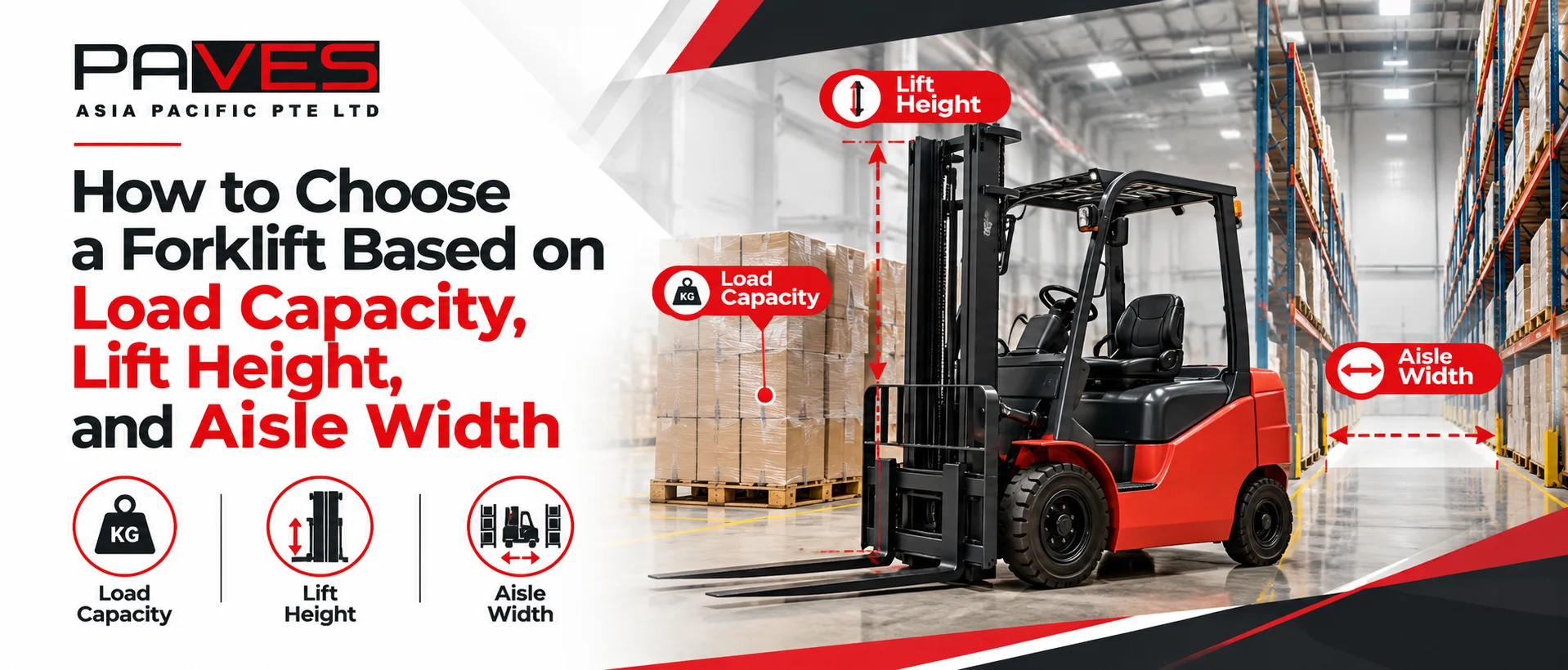
Choosing the right forklift is essential for safe material handling, efficient warehouse operations, and better use of available storage space. A forklift that cannot handle the required load, reach the necessary rack height, or maneuver through warehouse aisles can create operational delays and safety risks.
When comparing a forklift in Singapore, businesses should evaluate three essential factors: load capacity, lift height, and aisle width. Other considerations, including power source, floor conditions, operating hours, and maintenance requirements, also influence the final decision.
Whether you are planning to purchase equipment or exploring forklift rental in Singapore, understanding these specifications can help you select a machine suited to your warehouse, distribution center, or industrial facility.
How Do You Choose the Right Forklift?
Choose a forklift by matching its specifications to your actual workplace requirements.
- Load capacity: Confirm the maximum weight and dimensions of the loads you handle, including pallets and packaging.
- Lift height: Measure the highest rack position where goods must be placed or retrieved.
- Aisle width: Measure the narrowest working aisle and check the forklift’s required manoeuvring space.
- Forklift type: Consider counterbalance forklifts, reach trucks, or very narrow aisle models according to the layout.
- Power source: Compare electric and combustion-powered options based on the operating environment.
- Total cost: Evaluate purchase price or rental fees, maintenance, energy, servicing, and operator requirements.
Always verify the manufacturer’s capacity information for the intended load, lift height, mast, and attachments. A forklift’s rated capacity does not automatically apply under every operating condition.
1. Understand Your Required Load Capacity
Load capacity refers to the maximum load a forklift is rated to handle under specified conditions. Choosing a machine based only on the average weight of your goods can be a mistake because occasional heavier loads may exceed its safe operating limits.
Start by identifying the heaviest load that will be handled during normal operations. Include the weight of the pallet, packaging, and any additional materials lifted with the goods.
Consider the Load Centre
The load centre is the horizontal distance from the fork face to the load’s centre of gravity. If a load is longer, wider, or positioned differently from the manufacturer’s standard test conditions, the forklift’s available capacity may be reduced.
Attachments can also affect capacity. Before choosing a machine, ask the supplier to confirm the permitted load under your actual operating conditions.
Allow for the Real Working Requirements
Do not select a forklift simply because its advertised capacity matches the weight on your pallet. Confirm the capacity at the required lifting height and with the intended mast and attachments.
For example, a warehouse regularly handling heavy machinery components may need a different specification from a distribution centre handling standard palletised cartons. The correct choice depends on verified load weights, dimensions, handling frequency, and the manufacturer’s specifications.
2. Determine the Required Lift Height
Lift height is the maximum height at which a forklift can raise its forks or place a load. It is particularly important in warehouses that use multiple levels of pallet racking.
Measure the highest storage position where goods must be placed or retrieved. Also consider the height of the load, the required clearance above the rack beam, and any overhead obstructions.
Check Mast Height and Configuration
A forklift’s mast determines its lifting capability and affects its overall dimensions. A taller mast may be necessary for high-bay storage, but its lowered height must also fit beneath doorways, beams, and other overhead restrictions.
Check both the maximum lifting height and the mast’s lowered height before selecting a machine.
Verify Capacity at Height
The forklift’s available capacity may change with lifting height, mast configuration, and attachments. Confirm that the selected model can safely handle the required load at the actual placement height.
For warehouses with tall racking, a reach truck may be suitable because it is designed for high-level pallet storage in planned aisles. The final selection should still account for the load, rack design, and working environment.
3. Measure Warehouse Aisle Width
Aisle width determines how much room a forklift has to travel, turn, and position pallets. An unsuitable machine may struggle to manoeuvre around racks, increase handling time, or create safety concerns.
Measure the narrowest aisle, rather than relying on the average aisle width. Include the dimensions of the load and pallet, turning space, rack projections, columns, doorways, and any obstacles along the route.
Match the Forklift Type to the Available Space
- Counterbalance forklift: Suitable for many general material-handling tasks, loading bays, and operations with sufficient manoeuvring space.
- Reach truck: Designed for warehouse storage where higher racking and narrower aisles are important.
- Very narrow aisle forklift: Designed for specialised, space-efficient storage layouts with compatible aisle guidance or operating arrangements.
The correct choice depends on the truck’s turning characteristics, dimensions, load size, and the manufacturer’s aisle-width requirements. A compact machine does not necessarily guarantee that it can safely perform every turn within a given aisle.
4. Choose Between Electric and Other Forklift Types
The operating environment influences the most suitable power source.
Electric Forklifts
An electric forklift may be suitable for indoor warehouses, distribution centres, and facilities where low local emissions and reduced operating noise are priorities. Businesses should consider battery capacity, charging time, charging infrastructure, and the number of shifts worked each day.
When comparing an Electric Forklift Singapore option, confirm that the battery can support the expected workload and that suitable charging arrangements are available.
Combustion-Powered Forklifts
Depending on the model and application, diesel or other combustion-powered forklifts may be considered for outdoor work, demanding duty cycles, or certain industrial environments. Exhaust emissions, ventilation, surface conditions, fuel arrangements, and applicable workplace requirements must be considered.
The decision should reflect the actual working environment rather than assuming one power source is suitable for every facility.
5. Compare Forklift Rental and Purchase Options
Businesses can acquire equipment through purchasing or renting, depending on their expected usage and budget.
Forklift Rental Singapore may suit temporary projects, seasonal demand, warehouse expansion, or situations where additional handling capacity is needed for a limited period. Before renting, confirm availability, rental duration, maintenance arrangements, delivery charges, and breakdown support.
A Forklift for Sale Singapore search may be more appropriate when a machine is required regularly over a longer period. Compare the purchase price with financing, maintenance, battery replacement where applicable, servicing, insurance, and eventual resale value.
Forklift Hire Singapore can also be considered when the rental arrangement includes an operator or other support services. Check exactly what is included in the agreement.
6. Evaluate Warehouse Layout and Operating Conditions
The right forklift must fit the complete operating route, not just the storage aisle. Check the floor condition, gradients, loading docks, ramps, doorway dimensions, turning areas, and transitions between indoor and outdoor surfaces.
Warehouse Forklift Singapore requirements may vary considerably between a small distribution facility and a high-density storage warehouse.
Before choosing a model, consider:
- Daily operating hours and number of shifts.
- Load sizes and handling frequency.
- Required travel distances.
- Floor condition and available clearance.
- Visibility around racks and intersections.
- Battery charging or fuel arrangements.
- Maintenance access and operator training.
These details help narrow the available options and prevent the selection of equipment that is technically capable of lifting the load but unsuitable for the site.
7. Work With a Reliable Forklift Supplier
A reliable supplier should be able to explain equipment specifications, capacity limits, maintenance requirements, and the suitability of different models for your operating conditions.
When comparing a Forklift Supplier Singapore, ask for technical specifications, load charts, maintenance information, warranty terms, and details of after-sales support. For rental equipment, confirm replacement arrangements if a breakdown affects operations.
At Paves Asia Pacific Pte Ltd, businesses can discuss their material-handling requirements and explore suitable forklift options based on warehouse layout, load capacity, lift height, and aisle constraints.
Do not choose equipment based solely on the lowest quoted price. A machine that fits the operation correctly and receives appropriate maintenance may offer better long-term value than one that creates repeated handling difficulties.
Conclusion
Choosing the right forklift requires more than comparing advertised capacities or prices. Load weight, load centre, lifting height, aisle width, power source, and workplace conditions must all be considered together. By measuring the operating environment and confirming the manufacturer’s specifications, businesses can choose equipment that supports safe handling, efficient storage, and reliable daily operations. A suitable rental or purchase decision can then be made based on usage, budget, and long-term operational needs.
Frequently Asked Questions
Q1. How do I calculate the forklift capacity I need?
Identify the heaviest complete load, including its pallet and packaging. Then verify the manufacturer’s rated capacity for the load centre, lifting height, mast, and attachments you intend to use.
Q2. How do I choose a forklift for a narrow warehouse aisle?
Measure the narrowest aisle and compare it with the manufacturer’s required aisle width for your load and handling method. Reach trucks and specialized very narrow aisle models may be appropriate, depending on the layout.
Q3. Is an electric forklift suitable for warehouse use?
Electric forklifts can be suitable for many indoor applications. Consider battery capacity, charging arrangements, operating hours, floor conditions, and the manufacturer’s specifications before selecting a model.
Q4. Should I rent or buy a forklift in Singapore?
Renting may suit temporary or variable workloads, while purchasing may make sense for regular, long-term use. Compare the full rental cost with ownership, maintenance, financing, and operating expenses.
Q5. What should I check before choosing a forklift supplier?
Review technical guidance, equipment condition, maintenance support, warranty terms, spare-parts availability, and rental or purchase conditions. Confirm that the recommended forklift matches your load, lift height, and aisle requirements.