
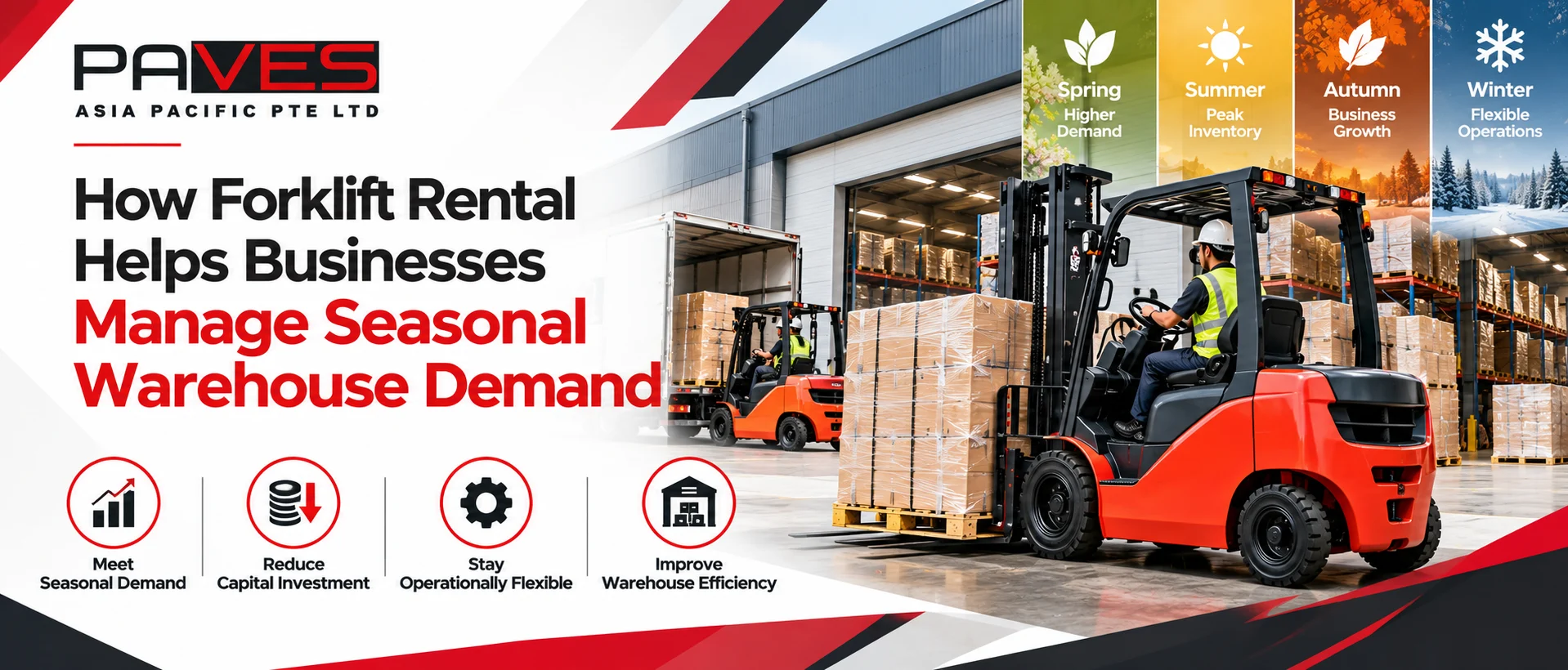
Warehouse demand rarely stays the same throughout the year. Retail promotions, festive shopping periods, year-end stock movements, e-commerce campaigns, and temporary distribution projects can increase the volume of goods that businesses need to receive, store, move, and dispatch. When orders rise suddenly, an existing forklift fleet may struggle to keep up.
Purchasing additional forklifts for a short peak period can tie up capital and leave businesses with unused equipment when demand returns to normal. Forklift rental in Singapore offers an alternative by allowing companies to increase material-handling capacity when required and reduce it when workloads decline.
How Does Forklift Rental Help Manage Seasonal Demand?
Forklift rental helps businesses manage seasonal warehouse demand by providing temporary access to suitable equipment without requiring a permanent increase in fleet size.
Key benefits include:
- Flexible capacity: Add forklifts during busy periods and return them when demand falls.
- Faster warehouse operations: Support receiving, pallet movement, replenishment, and dispatch.
- Lower upfront investment: Avoid purchasing additional machines solely for short-term requirements.
- Equipment choice: Select counterbalance forklifts, electric models, or reach trucks according to the task.
- Support during breakdowns: Arrange temporary replacement equipment when existing machines are unavailable, subject to rental terms.
- Better cost planning: Compare rental periods and service arrangements with the cost of owning additional equipment.
The best results come from forecasting demand early, selecting suitable machines, and confirming availability, maintenance support, operator requirements, and total rental costs.
1. Understand Why Seasonal Demand Creates Warehouse Challenges
During normal operating periods, a warehouse may have enough forklifts to handle incoming deliveries, move pallets between storage locations, replenish picking areas, and prepare outgoing shipments. During peak periods, these same activities may need to be completed in a shorter time.
This can create several operational problems:
- Goods wait longer at receiving bays.
- Pallets accumulate in temporary staging areas.
- Workers spend more time waiting for equipment.
- Replenishment falls behind order-picking requirements.
- Dispatch schedules become harder to maintain.
- Existing forklifts experience heavier utilisation.
Adding temporary equipment can help address these bottlenecks, provided the warehouse has enough space, trained operators, and an efficient traffic-management plan.
A forklift in Singapore may be needed for different reasons depending on the business. Retail distribution centres may experience demand around major sales events, while importers, manufacturers, and logistics providers may require additional handling capacity for project-specific shipments or inventory movements.
2. Use Forklift Rental to Increase Capacity During Peak Periods
Forklift rental allows businesses to match equipment availability more closely to their workload. Instead of purchasing additional units that may remain idle for much of the year, companies can arrange short-term or longer-term rentals around anticipated demand.
For example, a warehouse expecting a temporary increase in palletised deliveries could arrange additional forklifts for receiving and put-away operations. Another business might need extra machines to support dispatch during a promotional campaign.
The rental period should reflect the actual workload. A short-term arrangement may suit a brief stocktake or order surge, while a longer contract could be more appropriate for an extended peak season.
Rental availability and contract conditions vary by supplier, so businesses should confirm the delivery date, minimum rental period, extension terms, and collection arrangements before finalising their plans.
3. Choose the Right Forklift for Your Warehouse Tasks
Adding more equipment is not enough if the machines are unsuitable for the work. Selecting the correct type helps businesses use their available space efficiently and avoid unnecessary handling delays.
Electric Forklifts for Indoor Operations
An Electric Forklift Singapore option may suit warehouses that prioritise low local exhaust emissions and quieter operation. Electric models can support indoor pallet handling, provided the battery capacity, charging arrangements, load requirements, and operating hours match the workload.
Before renting, consider whether the machine can operate across the required shifts and whether charging or battery-swapping arrangements are available.
Reach Trucks for High-Rack Storage
Reach trucks are designed for warehouse applications where narrow aisles and elevated pallet storage are important. They may help businesses use vertical storage space efficiently without requiring the same aisle configuration as some conventional counterbalance forklifts.
Reach Truck Rental Singapore can be worth considering when seasonal stock volumes increase the need for high-rack put-away and retrieval. Check the required lift height, load capacity, aisle dimensions, and rack configuration before selecting a model.
Counterbalance Forklifts for General Handling
Counterbalance forklifts are commonly used for loading and unloading, pallet movement, and general material-handling tasks. Depending on the model, they may be suitable for warehouse floors, loading areas, or outdoor yards.
Choose equipment according to load weight, floor conditions, available manoeuvring space, and the operating environment.
4. Compare Rental Costs With Buying Additional Equipment
Buying forklifts can make sense when utilisation is consistently high. However, seasonal demand may not justify the expense of owning extra machines year-round.
Forklift Rental Singapore allows businesses to evaluate costs over the period when additional capacity is needed. The comparison should include more than the rental rate or purchase price.
| Cost factor | Rental considerations | Purchase considerations |
|---|---|---|
| Initial expenditure | Rental fees and possible deposit | Purchase price or financing |
| Maintenance | Depends on the rental agreement | Owner’s servicing and repair costs |
| Utilisation | Pay for the agreed rental period | Costs continue even when equipment is idle |
| Flexibility | Equipment can be returned after the term | Additional effort may be needed to sell surplus units |
| Availability | Must be confirmed with the supplier | Equipment is available when owned and operational |
| Long-term value | No ownership asset at the end | Potential resale value, subject to condition and market |
When evaluating a Forklift for Sale Singapore option, consider how often the machine will be used after the peak season. If additional capacity is required only occasionally, rental may provide greater flexibility. If the demand is permanent, buying or leasing may be worth comparing.
5. Plan Rental Periods Before the Busy Season
Waiting until the warehouse is already overloaded can make equipment planning more difficult. A proactive approach gives businesses time to assess capacity, confirm machine specifications, and arrange delivery.
Start by reviewing historical order volumes, incoming shipment schedules, promotional calendars, and expected stock levels. Identify the dates when receiving, put-away, picking, and dispatch are likely to experience the greatest pressure.
Next, estimate how many forklifts are needed for each shift and task. Avoid adding equipment without considering the space available for movement and staging. Too many machines in a restricted warehouse can increase congestion rather than improve productivity.
Contact a Forklift Supplier Singapore early to discuss availability and suitable models. Confirm the rental duration, delivery arrangements, servicing responsibilities, and procedures for requesting an extension if the busy period lasts longer than expected.
6. Check Maintenance, Breakdown Support, and Rental Terms
Equipment reliability is especially important when order volumes are high. A forklift breakdown during a peak period can disrupt receiving and dispatch, so the rental agreement should clearly explain maintenance responsibilities and support arrangements.
Before accepting a rental, confirm:
- Whether routine servicing is included.
- Who handles repairs and mechanical faults.
- How quickly the supplier responds to breakdowns.
- Whether replacement equipment may be available.
- Who pays for transport, fuel, and damage.
- What charges apply to overtime or rental extensions.
- How equipment condition is recorded at delivery and collection.
Forklift Hire Singapore arrangements may differ in whether an operator, maintenance package, or other services are included. Review the written quotation rather than assuming these items are part of the standard rate.
Inspect the machine before use, record existing damage, and ensure that safety features are working. Operators should follow workplace procedures and use equipment only within its rated capacity.
7. Maintain Safety While Increasing Warehouse Throughput
Increasing the number of forklifts does not automatically make a warehouse more productive. Safe routes, clear communication, trained operators, and suitable traffic controls are essential when more equipment is operating in the same space.
Review pedestrian walkways, loading zones, intersections, blind corners, and areas where forklifts reverse or turn. Separate pedestrian and vehicle movement where practical, maintain clear sightlines, and establish speed limits and right-of-way rules appropriate to the workplace.
Singapore’s Ministry of Manpower states that forklift operators must complete the WSQ Operate Forklift Course. It also sets out additional training requirements for operators handling forklifts above five tonnes. Employers should check current requirements and ensure that operators are appropriately trained for their equipment and duties.
A safe operating plan helps businesses handle increased volume without creating avoidable risks for workers, visitors, or goods.
8. Work With a Rental Provider That Understands Your Needs
A suitable rental provider should help you identify equipment that matches your load requirements, warehouse layout, operating hours, and rental period.
At Paves Asia Pacific Pte Ltd, businesses can discuss their material-handling requirements and explore forklift options suited to their operational needs.
Before confirming a booking, provide details about the heaviest loads, lifting height, aisle width, surface conditions, daily operating hours, and expected rental dates. Ask the supplier to confirm machine specifications and explain any additional costs or limitations.
For seasonal operations, it is also useful to establish a contact person for delivery coordination, maintenance queries, and rental extensions. Clear communication helps reduce uncertainty when schedules change.
Conclusion
Seasonal warehouse demand can place considerable pressure on equipment, labor, and dispatch schedules. Renting additional forklifts can help businesses respond to temporary workload increases, improve material flow, and avoid purchasing equipment that may remain unused during quieter months.
The most effective approach combines early demand forecasting, suitable forklift selection, clear rental terms, reliable maintenance support, and safe warehouse procedures. At Paves Asia Pacific Pte Ltd, businesses can discuss their equipment requirements and identify options to support changing material-handling needs.
By matching equipment capacity to actual demand, warehouse operators can work towards better productivity, greater flexibility, and more predictable equipment costs throughout the year.
Frequently Asked Questions
Q1. How does forklift rental help during seasonal warehouse demand?
It provides additional material-handling capacity during busy periods without requiring a permanent increase in fleet size. Businesses can arrange equipment for specific projects or peak periods and return it when demand decreases.
Q2. How early should I book a forklift for a peak season?
Start planning as soon as your expected demand period is known. Booking early gives you more time to confirm equipment availability, capacity, delivery, and operator requirements. The ideal lead time depends on the supplier and equipment type.
Q3. Should I rent or buy a forklift for seasonal use?
Rental may suit temporary demand because it avoids a long-term ownership commitment. Buying may be more suitable when the equipment will be used consistently throughout the year. Compare total costs and expected utilisation before deciding.
Q4. Which forklift is suitable for a warehouse with narrow aisles?
A reach truck or a specialised narrow-aisle model may be suitable, depending on load weight, rack height, aisle dimensions, and operating conditions. Confirm the manufacturer’s specifications before booking.
Q5. What should I check before signing a forklift rental agreement?
Review the rental period, total charges, machine specifications, maintenance, breakdown response, insurance, delivery, return conditions, and extension fees. Confirm which services are included in writing.