
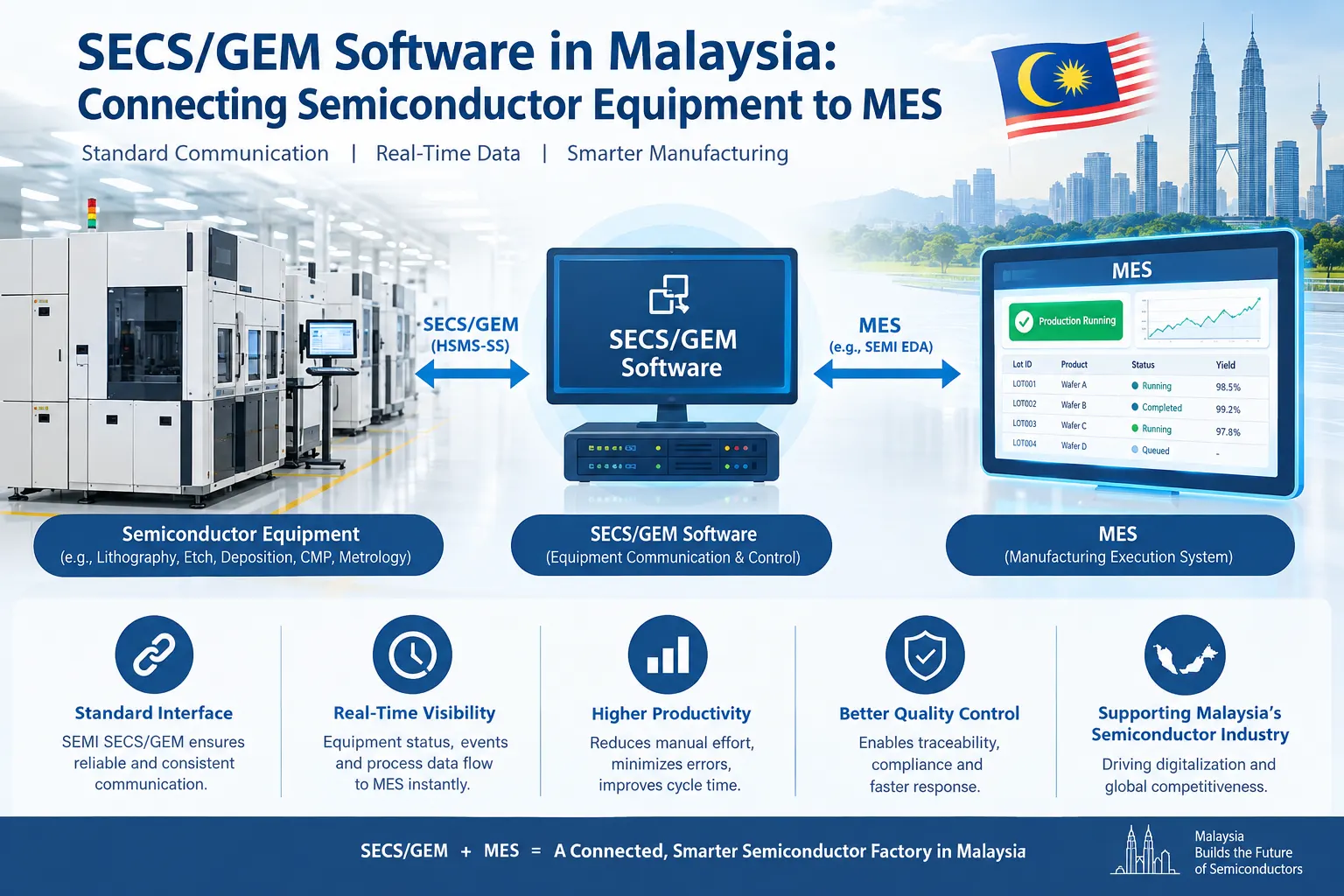
Semiconductor production depends on dependable communication between equipment and the systems that run the factory. When machines report status, alarms, and process events in a consistent way, engineers gain better visibility, stronger traceability, and a foundation for automation. SECS/GEM software in Malaysia plays a key role here. It lets compatible equipment exchange standardized messages with factory host systems, which in turn feed Manufacturing Execution Systems (MES). This article explains how that connection works, what to consider for legacy machines, and how to evaluate a solution.
Why Semiconductor Manufacturers in Malaysia Need Better Equipment Connectivity
Malaysia’s semiconductor and electronics sector includes wafer fabs, OSAT and ATMP facilities, and equipment manufacturers. Many of these sites run tools from multiple OEMs, and each may expose a different communication interface.
Common challenges include:
- Mixed equipment fleets: Machines from different vendors with different interfaces and data models.
- Older machines: Limited or no host communication capability.
- Manual data collection: Operators recording production information by hand, which is slow and error-prone.
- Inconsistent status and alarm data: Hard to compare across tools.
- Layered integration needs: Equipment, EAP, and MES must work together.
- Scalability: Adding tools or lines should not require starting integration from scratch.
Standardized equipment communication addresses many of these issues by giving every compatible tool a common way to report to the host.
What Is SECS/GEM Software?
SECS/GEM is a family of SEMI standards that define how semiconductor equipment talks to a factory host. In simple terms, it gives machines a shared language.
- SECS-I (SEMI E4): Serial communication between equipment and host.
- SECS-II (SEMI E5): Defines the structure and content of the messages exchanged.
- GEM (SEMI E30): Defines a common model for equipment communication and behavior.
- HSMS (SEMI E37): Carries SECS messages over TCP/IP networks.
SECS/GEM software provides the communication interface through which compatible equipment and host systems exchange information. The communication method and supported features depend on the equipment implementation and the integration requirements.
How SECS/GEM Software Connects Semiconductor Equipment to MES
A typical architecture looks like this:
Equipment / Machine Controller
↓
SECS/GEM Communication Interface
↓
HSMS over TCP/IP or Supported SECS-I Connection
↓
EAP / Factory Host
↓
Manufacturing Execution System (MES)
The equipment controller holds machine data and logic. The SECS/GEM interface translates that data into standard messages. HSMS or SECS-I carries those messages to the EAP or factory host, which interprets them and coordinates with the MES.
Common functions include:
- Equipment status monitoring
- Alarm reporting
- Collection event reporting
- Production data collection
- Remote commands, where supported
- Recipe upload and download, where supported
- Production traceability and host-system coordination
MES connectivity ultimately depends on the factory architecture, host implementation, and configured interface.
Key Benefits of SECS/GEM Equipment Integration
Standardized integration turns scattered machine data into information that production teams can use.
| Integration Capability | Operational Benefit |
| Equipment status monitoring | Improves visibility into machine operating conditions |
| Alarm and event reporting | Helps teams identify equipment issues and investigate events |
| Automated data collection | Reduces dependence on manual production records |
| Recipe management | Supports controlled recipe exchange when implemented |
| MES connectivity | Enables equipment data to support production workflows |
| Standardized communication | Helps create a consistent integration approach across supported equipment |
Actual benefits depend on equipment capabilities, interface configuration, and factory implementation. Results vary by site, so projects should define their own measurable goals.
Integrating Legacy Semiconductor Equipment with SECS/GEM Software
Many factories run reliable machines that were built before host connectivity was a priority. Replacing them is often impractical, so legacy equipment connectivity becomes an important consideration.
A good starting point is to assess existing PLCs, HMIs, industrial PCs, available data points, and communication interfaces. Depending on what is accessible, software interfaces, gateways, or external connectivity solutions may help expose supported equipment data to factory systems without complete machine replacement.
Key considerations:
- Compatibility with existing equipment
- Availability and quality of machine data
- Controller access and integration limitations
- Network and cybersecurity requirements
- Testing, validation, and operational safety
- Preserving the original equipment control and safety logic
A non-invasive approach may suit selected machines, but feasibility must be evaluated for each one.
Choosing the Right SECS/GEM Software for Semiconductor Manufacturing in Malaysia
Whether you are a fab, an OSAT, or an equipment OEM, evaluate options against these criteria:
- Support for the required SEMI standards and communication methods
- Compatibility with existing equipment and host systems
- Availability of required GEM functions and message handling
- Support for event reporting, alarms, status variables, and remote commands
- Recipe management capabilities, where required
- Integration with EAP and MES architectures
- Testing tools, documentation, troubleshooting, and technical support
- Scalability for additional equipment and future automation
Validate supported features against your equipment specifications and host requirements before selecting a solution.
How eInnoSys Supports Semiconductor Equipment Connectivity
eInnoSys provides semiconductor equipment connectivity and factory automation solutions. Relevant offerings include:
- EIGEMEquipment: A SECS/GEM SDK and implementation services for developing or integrating equipment communication interfaces.
- EIGEMBox equipment connectivity: A solution designed to help connect supported equipment with factory automation systems.
- EIGEM-HMI: Software for integrating HMI- and PLC-based equipment interfaces with SECS/GEM communication.
Depending on project requirements, these categories can support equipment integration, data exchange, and legacy equipment modernization. Explore eInnoSys SECS/GEM equipment integration solutions to see which fits your use case.
Conclusion
SECS/GEM software is a core building block of semiconductor equipment connectivity and MES integration. It brings standardized communication, better equipment data visibility, and a practical path toward automation, including for legacy machines when assessment shows it is feasible.
For teams planning SECS/GEM software in Malaysia, sensible next steps are to inventory your equipment and interfaces, define the data and commands your MES needs, shortlist solutions against the criteria above, and pilot on a representative tool before scaling.
It supports standardized communication between equipment and a factory host. This enables equipment monitoring, alarm and event reporting, production data collection, and automation, giving engineers consistent visibility across compatible tools.
The SECS/GEM interface sends standardized messages from the equipment to an EAP or factory host. The host processes this information and exchanges relevant data with the MES. The exact flow depends on the factory architecture and host implementation.
Often it can, when suitable data access and interfaces exist. Teams should assess the PLC, HMI, controller, and available data points first. Feasibility varies by machine, so each tool needs individual evaluation before integration begins.
SECS/GEM defines how equipment communicates and behaves toward a host. MES manages manufacturing execution, including production workflows, tracking, and control. SECS/GEM helps supply equipment data and commands that MES and EAP layers use.
Assess equipment compatibility, required SEMI standards, host-system requirements, documentation, testing tools, and technical support. Validate supported features against your equipment specifications, and consider how easily the solution scales to additional tools.