
Summary
- The software development lifecycle (SDLC) provides a structured framework for creating high-quality applications efficiently.
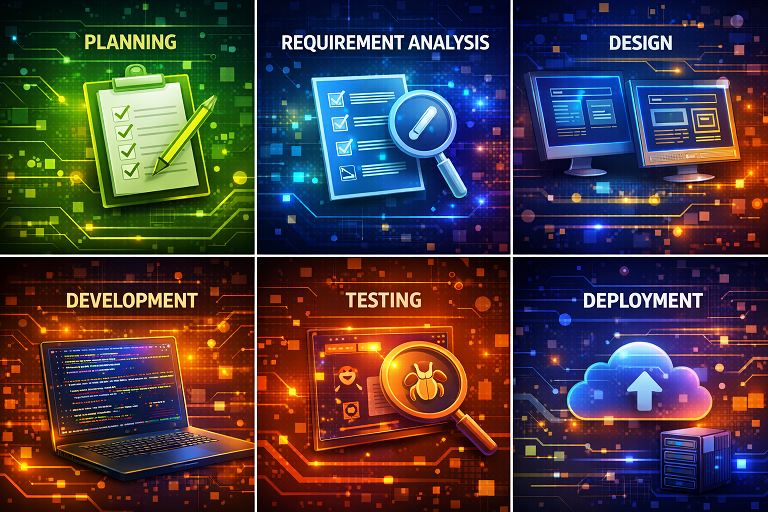
- The SDLC process consists of several distinct stages of software development, including planning, design, and maintenance.
- Different software development life cycle models, such as Agile, Waterfall, and DevOps, cater to varying project requirements.
- Implementing a formal SDLC offers significant SDLC advantages and disadvantages depending on the chosen methodology.
- Understanding SDLC phases helps teams reduce costs, meet deadlines, and minimize technical debt.
Introduction
According to a 2023 report by the Consortium for Information & Software Quality (CISQ), the annual cost of poor software quality in the US reached a staggering $2.41 trillion (CISQ — 2023). This massive figure highlights a painful truth: coding without a plan is a recipe for financial disaster. To combat this, engineering teams rely on the software development lifecycle, a systematic process intended to produce high-quality software that meets or exceeds customer expectations.
The SDLC process functions as a roadmap, guiding a project from its initial spark of an idea through to its eventual retirement. Without this structure, developers often find themselves lost in a sea of “spaghetti code” and missed deadlines. By adhering to specific stages of software development, organizations ensure that every line of code serves a purpose and every feature aligns with business goals.
Whether you are a student or a junior developer, mastering these frameworks is essential for professional growth. This guide explores the core SDLC phases, various software development life cycle models, and the practical SDLC examples that define the industry today.
What is the Software Development Lifecycle?
At its core, the SDLC is a methodology used by the tech industry to design, develop, and test high-quality software. It aims to deliver a product that is cost-effective and finishes within the shortest possible time frame while remaining functional.
Why Structure Matters
Think of the SDLC as the recipe for a complex five-course meal. If you try to bake the cake before you have gathered the flour, the kitchen will descend into chaos. In a technical context, skipping the analysis phase to start coding immediately leads to features that users never actually requested.
The Goal of a Uniform Process
The primary objective involves reducing waste and increasing the predictability of a project. By breaking a large project into smaller, manageable chunks, teams can track progress with greater accuracy. This clarity assists project managers in providing realistic timelines to stakeholders.
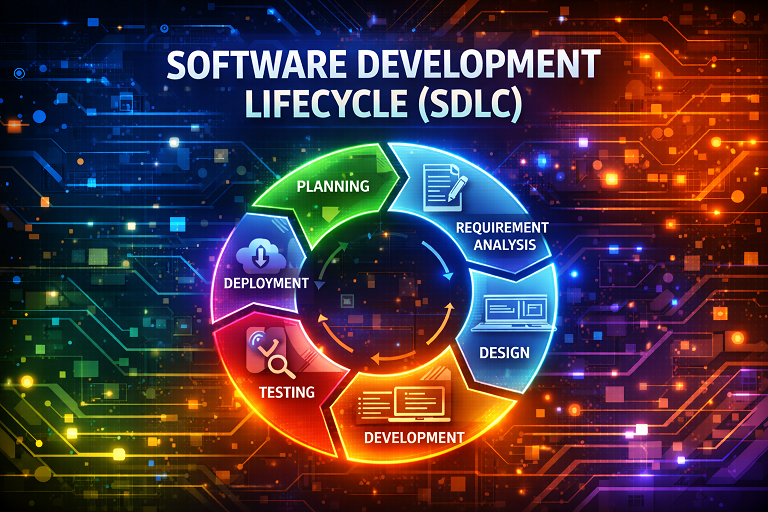
The 7 Core SDLC Phases
Every successful project moves through a series of logical steps. While different organizations might rename them, these seven SDLC phases remain the standard pillars of the industry.
1. Requirement Analysis and Planning
This initial step is the most crucial. Senior members of the team gather detailed requirements from stakeholders, customers, and sales departments. This phase defines “what” the software needs to do.
According to Gartner (2024), approximately 70% of project failures stem from poor requirements gathering (Gartner — 2024). Teams create a Software Requirement Specification (SRS) document to serve as a single source of truth for the rest of the project.
2. Feasibility Study
Once requirements are clear, the team assesses if the project is doable. They look at economic, legal, and technical factors. Can we build this within the budget? Do we have the right talent? If the answer is “no,” the project stops here before any money is wasted.
3. Design and Architecture
Developers and architects create the “blueprints.” This includes the High-Level Design (HLD) and Low-Level Design (LLD). They decide on the programming languages, databases, and third-party tools.
4. Software Development (Coding)
This is where the actual building happens. Developers follow the design documents to write code. If the previous phases were handled correctly, this stage should be straightforward. However, this is also where developers consume record-breaking amounts of coffee.
5. Testing and Quality Assurance
Before the software reaches the user, it must be poked, prodded, and challenged. Testers look for bugs, security vulnerabilities, and performance bottlenecks. The goal is to verify that the software behaves exactly as described in the SRS document.
6. Deployment
The software is released to the production environment. This might happen in stages. For example, a “beta” version might be released to a small group of users to gather feedback before a full-scale launch.
7. Operations and Maintenance
Software is never truly “finished.” Once it is in the hands of users, new bugs will surface and new feature requests will arrive. This phase involves regular updates and patches to keep the system running smoothly.
Popular Software Development Life Cycle Models
There is no “one size fits all” approach to building software. Depending on the project size and goals, teams choose from several software development life cycle models.
The Waterfall Model
This is the oldest and most traditional approach. It follows a linear, sequential path. You complete one phase entirely before moving to the next.
- Best for: Projects with clear, unchanging requirements (e.g., government contracts).
- Drawback: It is very rigid. Changing a requirement late in the process is incredibly expensive.
The Agile Model
Agile focuses on iterative development and customer feedback. Instead of one giant release, the team delivers small, functional pieces of software in “sprints.”
According to the 17th Annual State of Agile Report (2024), 71% of organizations utilize Agile to increase their speed to market (Digital.ai — 2024). It allows teams to pivot quickly if the market changes.
The V-Model (Validation and Verification)
This model is an extension of Waterfall. It pairs every development phase with a corresponding testing phase. It creates a “V” shape, ensuring that testing is planned from the very beginning.
The Spiral Model
The Spiral model emphasizes risk assessment. It is a mix of iterative prototyping and the Waterfall method. It works well for large, expensive, and complicated projects where the risk of failure is high.
DevOps
DevOps is more of a cultural shift than a mere model. It blends development (Dev) and operations (Ops) to shorten the SDLC process. It relies heavily on automation and continuous integration/continuous deployment (CI/CD) pipelines.
SDLC Examples in the Real World
To see these models in action, let’s look at two different SDLC examples.
Case A: Building a Banking App
A bank needs a highly secure mobile app. Due to strict regulations and the need for extreme precision, they might use a hybrid of the V-Model and Waterfall. Every requirement must be verified against a specific test case to ensure no financial data is ever compromised.
Case B: Developing a New Social Media Feature
A startup wants to add “Stories” to its app. They use Agile. They release a basic version to 5% of their users, see how they interact with it, and then refine the feature based on real-world data.
SDLC Advantages and Disadvantages
Every methodology has its trade-offs. Choosing the right one requires balancing speed, cost, and quality.
Comparison of SDLC Approaches
| Model | SDLC Advantages | SDLC Disadvantages |
| Waterfall | Easy to manage; clear milestones. | Hard to change; late testing. |
| Agile | Fast feedback; high flexibility. | Scope creep; needs high collaboration. |
| Spiral | Excellent risk management. | Can be expensive and complex. |
| V-Model | High quality; early test planning. | Rigid; lacks flexibility for changes. |
Why Use an SDLC at All?
The biggest advantage is visibility. When everyone understands the process, there are fewer surprises. However, a disadvantage exists if the process becomes too bureaucratic, slowing down talented developers with unnecessary paperwork.
The Role of a Software Developer in the Lifecycle
While project managers guide the ship, the software developer is the one in the engine room making sure everything runs. In a modern SDLC, their role has expanded beyond just writing syntax. They are now expected to participate in requirement discussions, write their own unit tests, and often manage their own deployment pipelines.
How often have you seen a project where the coders had no idea what the business goal was? It usually ends in a product that is technically perfect but commercially useless. By being involved in every stage of the SDLC process, developers gain the context needed to make better architectural decisions.
Common Pitfalls to Avoid
Even with a perfect model, things can go wrong. A common mistake involves treating the SDLC as a “set it and forget it” checklist.
Do you remember that time a “minor” update crashed a major social media platform for six hours? That usually happens when the maintenance and testing phases are rushed. Avoid the temptation to skip documentation. While it feels tedious, the person who has to fix your code three years from now will thank you.
Conclusion
The software development lifecycle is more than just a corporate buzzword. It is a vital framework that transforms a chaotic collection of ideas into a functional, secure, and valuable piece of technology. By mastering the various SDLC phases and choosing the right software development life cycle models, teams can navigate the complexities of modern engineering with confidence.