
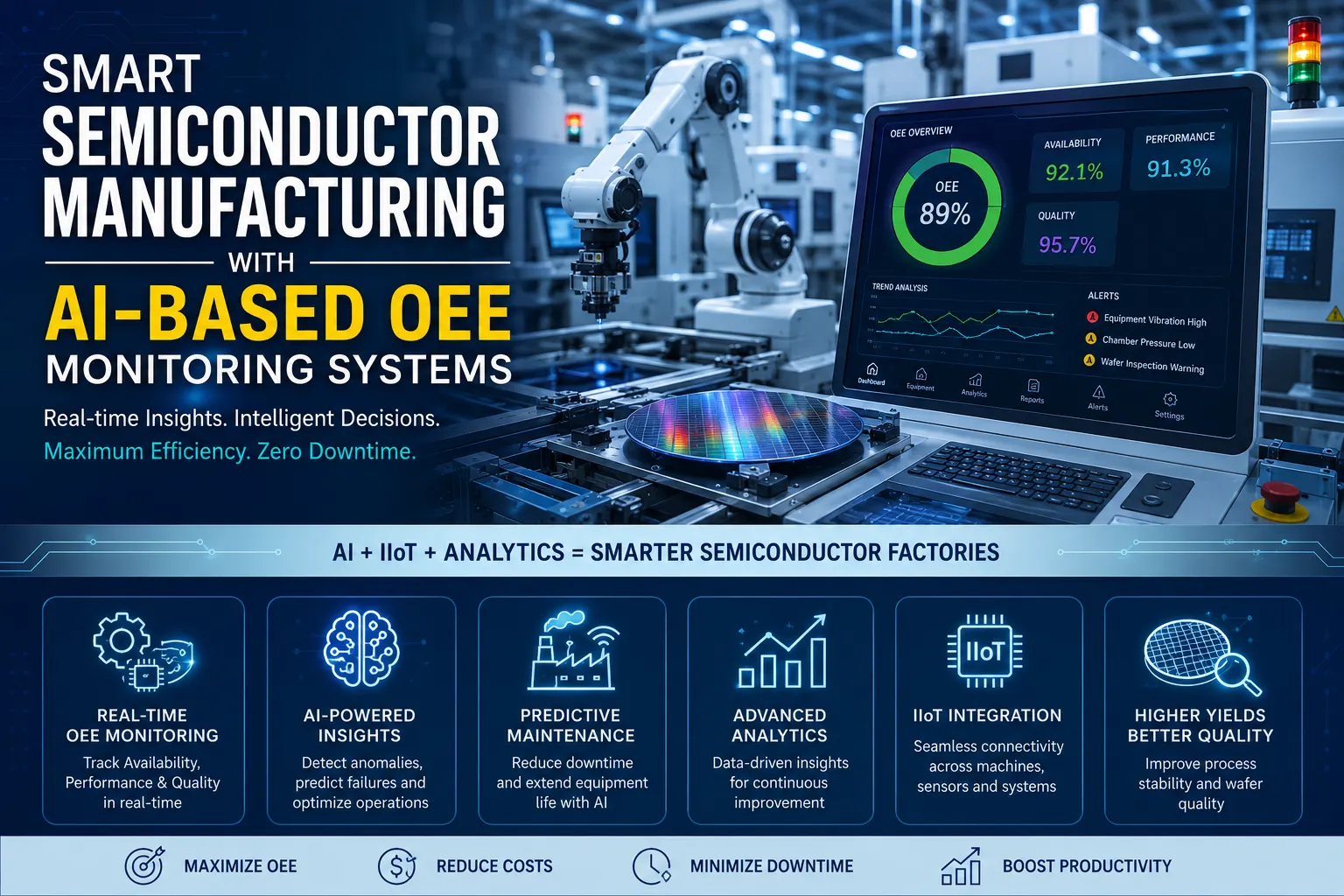
The semiconductor industry operates at a scale of precision that few other industries can match. A single fabrication plant — or fab — may run hundreds of process steps across thousands of wafers simultaneously, with equipment uptime directly tied to revenue measured in millions of dollars per hour. In this environment, traditional approaches to performance tracking are no longer sufficient. Smart Semiconductor Manufacturing is not a future aspiration; it is the operational standard that competitive fabs are adopting right now, driven by advances in AI, Industrial IoT, and real-time analytics.
At the heart of this shift is a deceptively simple metric: Overall Equipment Effectiveness (OEE). Originally developed for general manufacturing, OEE has evolved into a sophisticated intelligence layer within modern Semiconductor Manufacturing. When powered by AI, it becomes a dynamic, predictive system — one that does far more than report what happened yesterday.
Why OEE Alone Is No Longer Enough
Traditional OEE measurement captures three factors: availability, performance, and quality. For decades, engineers calculated these figures manually or through basic SCADA integrations, reviewing shift reports after the fact. In a fab running 24/7 with sub-nanometer tolerances, that lag is operationally unacceptable.
This is where AI-Based OEE Monitoring fundamentally changes the equation. Rather than a weekly dashboard, AI-powered systems ingest continuous streams of sensor data from lithography tools, CVD chambers, CMP equipment, and etch systems — correlating subtle pattern shifts with early indicators of degradation. The result is situational awareness that no human team, regardless of experience, can replicate at machine speed.
Modern OEE Monitoring Systems built for semiconductor environments are purpose-built to handle this complexity. They account for equipment qualification states (like QUAL and ENG runs that should be excluded from production OEE), recipe-level variation, and lot-based quality outcomes — nuances that generic manufacturing software misses entirely.
The Architecture of AI-Driven Semiconductor OEE
A well-designed Semiconductor OEE Software platform sits at the intersection of equipment integration, data science, and process engineering. Its architecture typically spans three layers:
- Equipment Integration Layer
Using SEMI standards such as SECS/GEM and GEM300, the platform connects directly to fab equipment — collecting event logs, alarm histories, process parameter traces, and chamber-level telemetry. This is where Semiconductor Equipment Monitoring begins: at the raw signal level, before any aggregation. - Analytics and AI Layer
Here, machine learning models trained on historical fab data detect anomalies, classify fault signatures, and calculate real-time OEE at the tool, chamber, and fleet level. Algorithms for Semiconductor Predictive Maintenance monitor leading indicators — such as RF power drift in etch tools or coolant temperature variance in CMP systems — before they trigger hard alarms or yield loss. - Decision Support Layer
This is where Real-Time OEE Monitoring surfaces as actionable intelligence. Engineers and operations managers see live OEE scores, drill-down root cause trees, and prioritized maintenance recommendations — not raw data dumps. Integration with Semiconductor MES Software ensures that equipment status, lot scheduling, and process outcomes are connected in a closed-loop system.
Semiconductor Industry 4.0 in Practice
The convergence of AI, Industrial IoT, and Semiconductor Factory Automation defines what practitioners now call Semiconductor Industry 4.0. Unlike earlier waves of automation that focused on replacing manual steps, this generation focuses on intelligence — making every automated action smarter, faster, and more adaptive.
Consider a real-world scenario: an ion implanter in a high-volume logic fab shows a gradual decline in beam current stability. A traditional system flags this as a minor process alert. An AI-based platform, drawing on Semiconductor Data Analytics across thousands of similar tool histories, recognizes the signature as a precursor to a beam source failure — statistically 72 hours before the hard failure occurs. Maintenance is scheduled during a planned idle window. Zero unplanned downtime. Zero affected wafers.
This is the practical promise of Smart Manufacturing in the semiconductor context: not automation for its own sake, but automation that learns, adapts, and continuously improves.
From Monitoring to Yield Improvement
The link between equipment health and Semiconductor Yield Improvement is well-established in the literature — but the ability to act on it in real time is new. AI-driven Semiconductor Process Monitoring correlates equipment OEE data with inline metrology measurements and final electrical test results, building a continuous feedback loop between tool performance and wafer outcomes.
For example, variations in gate oxide thickness — a critical parameter in logic devices — can often be traced upstream to subtle temperature non-uniformities in furnace equipment. Semiconductor Analytics platforms that ingest both process and equipment data can identify these correlations automatically, enabling engineers to tighten control limits before yield loss materializes.
This capability represents a step change in how fabs approach continuous improvement. Rather than retrospective failure analysis, AI in Semiconductor Manufacturing enables prospective process control — adjusting parameters, triggering PM cycles, and reallocating lots based on predicted outcomes rather than measured ones.
Integrating Smart Factory Solutions Across the Fab
No tool in a fab operates in isolation. The power of Semiconductor Manufacturing Software lies in its ability to integrate across the entire factory ecosystem — connecting equipment monitoring with scheduling, supply chain signals, workforce management, and customer delivery commitments.
Factory Automation Systems that incorporate AI-based OEE intelligence can dynamically reprioritize lot flows when a critical tool is flagged for predictive maintenance, automatically rerouting production to qualified alternates while dispatching maintenance crews with pre-staged parts. This level of coordination — what Smart Factory Solutions vendors describe as autonomous operations — reduces the human decision latency that historically turned minor equipment events into major production disruptions.
Industrial Automation in this context is not about eliminating engineers; it is about elevating them. With AI handling routine monitoring and anomaly detection, process engineers can focus on higher-order optimization — developing new recipes, improving yield models, and evaluating next-generation equipment qualifications.
Conclusion: Building the Intelligent Fab
The semiconductor industry is entering an era where competitive advantage will be determined not just by process technology, but by operational intelligence. Semiconductor Equipment Automation paired with AI-based analytics is no longer a differentiator — it is becoming the baseline for fabs that intend to remain relevant in an era of shrinking geometries, rising complexity, and unrelenting cost pressure.
Investing in a robust AI-Based Manufacturing and OEE platform is, at its core, an investment in visibility — the ability to see what is happening, understand why, and act before consequences compound. For organizations committed to Semiconductor Manufacturing excellence, the question is no longer whether to adopt AI-driven OEE monitoring, but how quickly that capability can be deployed, integrated, and scaled across the full equipment fleet.
The fabs winning today are those that have already made that decision. The fabs that will win tomorrow are those making it now.
OEE (Overall Equipment Effectiveness) monitoring in semiconductor manufacturing is a real-time performance measurement framework that tracks three core factors — equipment availability, production performance, and product quality — across fab tools such as lithography systems, etch chambers, and CMP equipment. Unlike generic OEE tools, semiconductor-specific OEE software accounts for SEMI-standard equipment states, recipe-level variation, and wafer-level quality outcomes, giving fab engineers and operations teams a precise, actionable view of how effectively their equipment is producing good product.
AI enhances OEE monitoring by moving beyond historical reporting into predictive and prescriptive intelligence. In a semiconductor fab, AI models continuously analyze equipment sensor streams — such as RF power signatures, temperature traces, and gas flow telemetry — to detect early degradation patterns before they cause alarms or yield loss. This enables maintenance teams to act during planned idle windows rather than after costly unplanned failures. AI-based OEE monitoring also correlates equipment performance data with inline metrology and final test results, helping process engineers identify root causes of yield variation faster and with greater accuracy than manual analysis.
Semiconductor MES (Manufacturing Execution System) software manages the full production workflow — lot scheduling, recipe dispatch, material tracking, and operator instructions — across the fab. OEE monitoring software, by contrast, focuses specifically on equipment effectiveness: measuring uptime, throughput, and quality at the tool and chamber level. In a modern smart fab, these two systems are integrated: MES software provides lot and process context, while OEE monitoring software provides equipment health intelligence. Together, they enable closed-loop control where equipment status directly influences scheduling and dispatch decisions in real time.
Real-time OEE monitoring contributes to yield improvement by closing the gap between equipment behavior and process outcomes. When a tool’s OEE drops — even subtly — it often signals an upstream process drift that will affect wafer quality before metrology or final test catches it. AI-driven semiconductor analytics platforms correlate these equipment signals with yield data, enabling engineers to tighten process control limits, trigger preventive maintenance cycles, and reroute sensitive lots away from underperforming tools. Over time, this continuous feedback loop reduces excursion frequency, shrinks the cost of poor quality, and systematically improves overall fab yield.
When evaluating an AI-based OEE monitoring system, semiconductor manufacturers should prioritize five capabilities:
(1) Native equipment integration via SECS/GEM and GEM300 standards for accurate, low-latency data collection;
(2) Semiconductor-specific OEE logic that correctly handles QUAL runs, PM states, and engineering lots;
(3) Predictive maintenance models trained on semiconductor equipment failure signatures, not generic industrial data;
(4) MES and process data integration to correlate equipment health with wafer-level outcomes; and (5) Scalable real-time architecture capable of handling high-frequency telemetry across hundreds of tools simultaneously. Platforms that meet all five criteria deliver measurable ROI through reduced downtime, improved yield, and lower cost of ownership.