
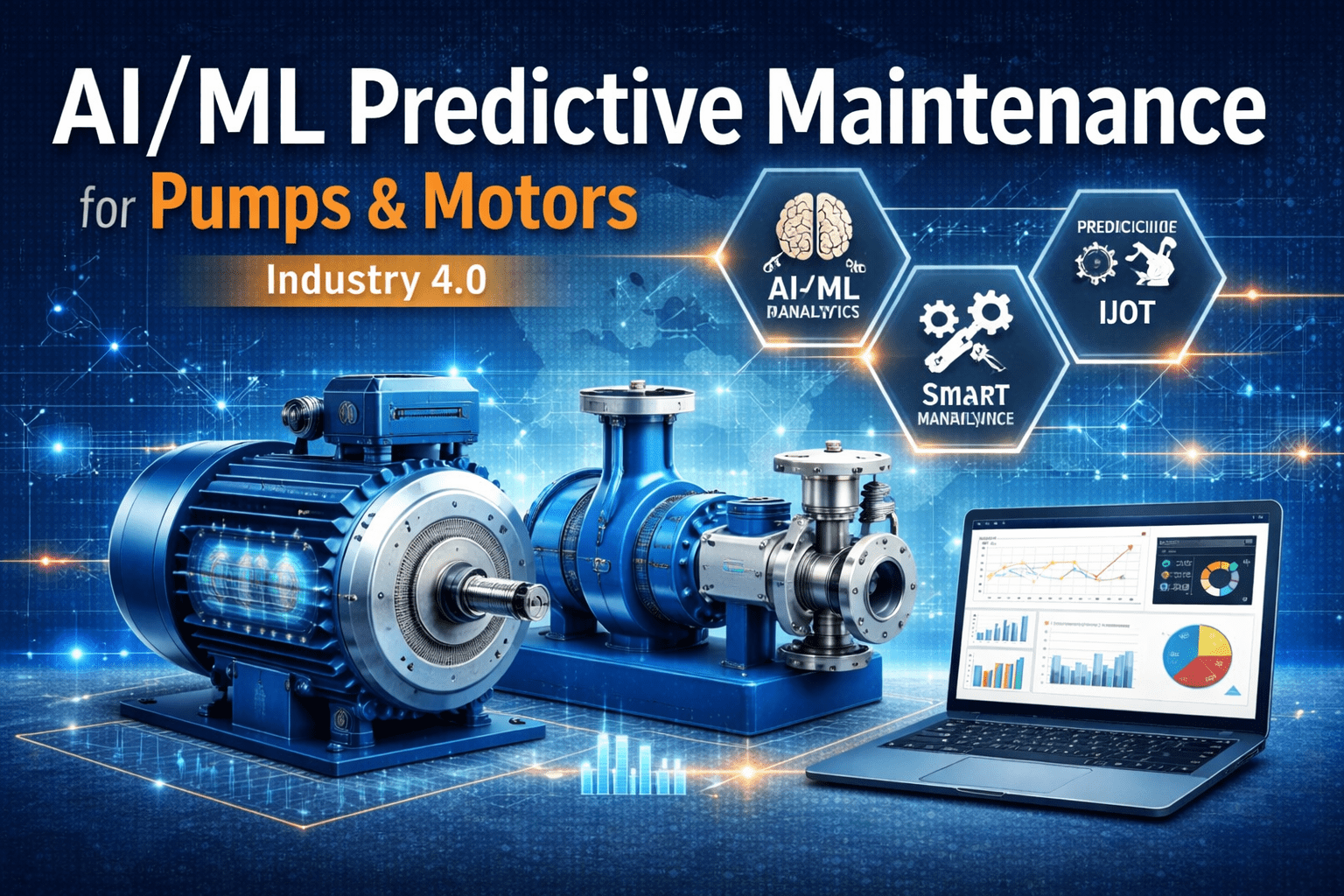
Industrial operations are under constant pressure to improve efficiency, reduce downtime, and extend equipment life. Pumps and motors—being the backbone of most industrial processes—are critical assets that demand continuous monitoring and maintenance. Traditional maintenance strategies, such as reactive and preventive maintenance, often fall short in preventing unexpected failures.
This is where AI predictive maintenance and machine learning predictive maintenance are transforming the landscape. By leveraging advanced algorithms and real-time data, industries can now implement predictive maintenance for pumps and motors with higher accuracy and reliability.
Understanding Predictive Maintenance in Industry 4.0
Predictive maintenance for pumps and motors is a data-driven approach that uses AI and machine learning to predict equipment failures before they occur. Unlike traditional maintenance methods, predictive maintenance relies on real-time insights and historical data patterns.
With Industry 4.0, the integration of IoT, AI, and automation has enabled the development of industrial predictive maintenance solutions that can monitor equipment health continuously.
Key Advantages:
- Reduced unplanned downtime
- Lower maintenance costs
- Increased equipment lifespan
- Improved operational efficiency
- Enhanced safety and reliability
Role of AI and Machine Learning in Predictive Maintenance
AI-based maintenance systems use machine learning models to analyze large volumes of sensor data collected from pumps and motors. These systems identify patterns, detect anomalies, and predict failures with high precision.
How It Works:
- Sensors collect data (vibration, temperature, pressure, current)
- Data is transmitted to a central system
- Machine learning algorithms analyze trends
- Alerts are generated for potential failures
This approach enables machine learning for motor failure prediction and ensures timely intervention before breakdowns occur.
Key Technologies Behind AI Predictive Maintenance
- Industrial IoT (IIoT)
Industrial IoT predictive maintenance for pumps relies on connected sensors that continuously monitor equipment performance.
- Data Analytics
Advanced analytics process real-time and historical data to identify performance deviations.
- Edge Computing
Reduces latency by processing data closer to the equipment.
- Cloud Computing
Stores and analyzes large datasets for long-term insights.
These technologies together create a powerful real-time equipment monitoring system.
Condition Monitoring for Pumps and Motors
Condition monitoring for pumps and motors is a crucial component of predictive maintenance. It involves tracking key parameters to assess equipment health.
Common Monitoring Parameters:
- Vibration levels
- Temperature variations
- Motor current signature
- Flow rate and pressure
- Acoustic signals
Using AI-based condition monitoring for rotating equipment, industries can detect early signs of wear, misalignment, or imbalance.
Pump Predictive Maintenance System
A robust pump predictive maintenance system integrates sensors, AI models, and monitoring software to ensure optimal performance.
Features:
- Real-time pump monitoring using AI and ML
- Fault detection and diagnostics
- Performance optimization
- Energy efficiency tracking
Such systems are essential for industries like oil & gas, water treatment, and manufacturing.
Motor Predictive Maintenance Using AI
Electric motors are widely used across industries, making motor predictive maintenance a critical requirement.
Techniques Used:
- Motor Current Signature Analysis (MCSA)
- Vibration analysis
- Thermal imaging
- AI-driven anomaly detection
By implementing predictive maintenance for electric motors using AI, industries can significantly reduce failure rates and improve reliability.
Real-Time Pump Monitoring Using AI and ML
A real-time equipment monitoring system powered by AI provides instant visibility into equipment performance.
Benefits:
- Immediate fault detection
- Continuous performance tracking
- Data-driven decision making
- Reduced maintenance delays
Real-time pump monitoring using AI and ML ensures that issues are identified and resolved before they escalate.
AI Predictive Maintenance in Industrial Automation
AI predictive maintenance in industrial automation is a key driver of smart factories. By integrating predictive maintenance systems with automation platforms, industries can achieve higher efficiency and productivity.
Use Cases:
- Automated fault detection
- Predictive alerts for maintenance teams
- Integration with SCADA and MES systems
- Remote monitoring and control
This enables seamless smart maintenance for industrial equipment.
Predictive Maintenance Software for Pumps and Motors
Modern predictive maintenance software for pumps and motors provides advanced tools for monitoring, analysis, and reporting.
Key Features:
- Dashboard visualization
- Predictive analytics
- Alarm management
- Historical data tracking
- Integration with enterprise systems
These solutions are part of broader smart factory predictive maintenance solutions.
Challenges in Implementing AI-Based Maintenance Systems
Despite its advantages, implementing an AI-based maintenance system comes with challenges:
Common Challenges:
- High initial investment
- Data quality and availability issues
- Integration with legacy systems
- Skilled workforce requirements
Solutions:
- Start with pilot projects
- Use scalable cloud-based platforms
- Invest in training and development
- Partner with experienced solution providers
Real-World Benefits of Predictive Maintenance
Companies adopting industrial predictive maintenance solutions report significant improvements:
- 30–50% reduction in downtime
- 20–40% reduction in maintenance costs
- Increased equipment lifespan
- Improved production efficiency
These benefits make predictive maintenance a critical component of Industry 4.0.
Future of AI/ML Predictive Maintenance
The future of AI predictive maintenance is driven by innovation and technological advancements.
Emerging Trends:
- Digital twins for equipment simulation
- AI-powered autonomous maintenance systems
- Advanced anomaly detection algorithms
- Integration with augmented reality (AR)
- Enhanced cybersecurity for industrial systems
These advancements will further strengthen machine learning predictive maintenance capabilities.
Best Practices for Implementation
To successfully implement predictive maintenance for pumps and motors, consider the following:
- Define clear objectives and KPIs
- Select the right sensors and data sources
- Ensure data accuracy and consistency
- Choose scalable AI platforms
- Continuously optimize models
Following these practices ensures effective deployment of predictive maintenance systems for industrial pumps.
Conclusion
The adoption of AI/ML based predictive maintenance for pumps and motors is revolutionizing industrial operations. By combining AI, machine learning, and IIoT technologies, industries can implement advanced condition monitoring for pumps and motors and build efficient real-time equipment monitoring systems.
From reducing downtime to improving operational efficiency, predictive maintenance is a cornerstone of Industry 4.0. As industries continue to evolve, investing in smart factory predictive maintenance solutions will be essential for staying competitive and achieving long-term success.