
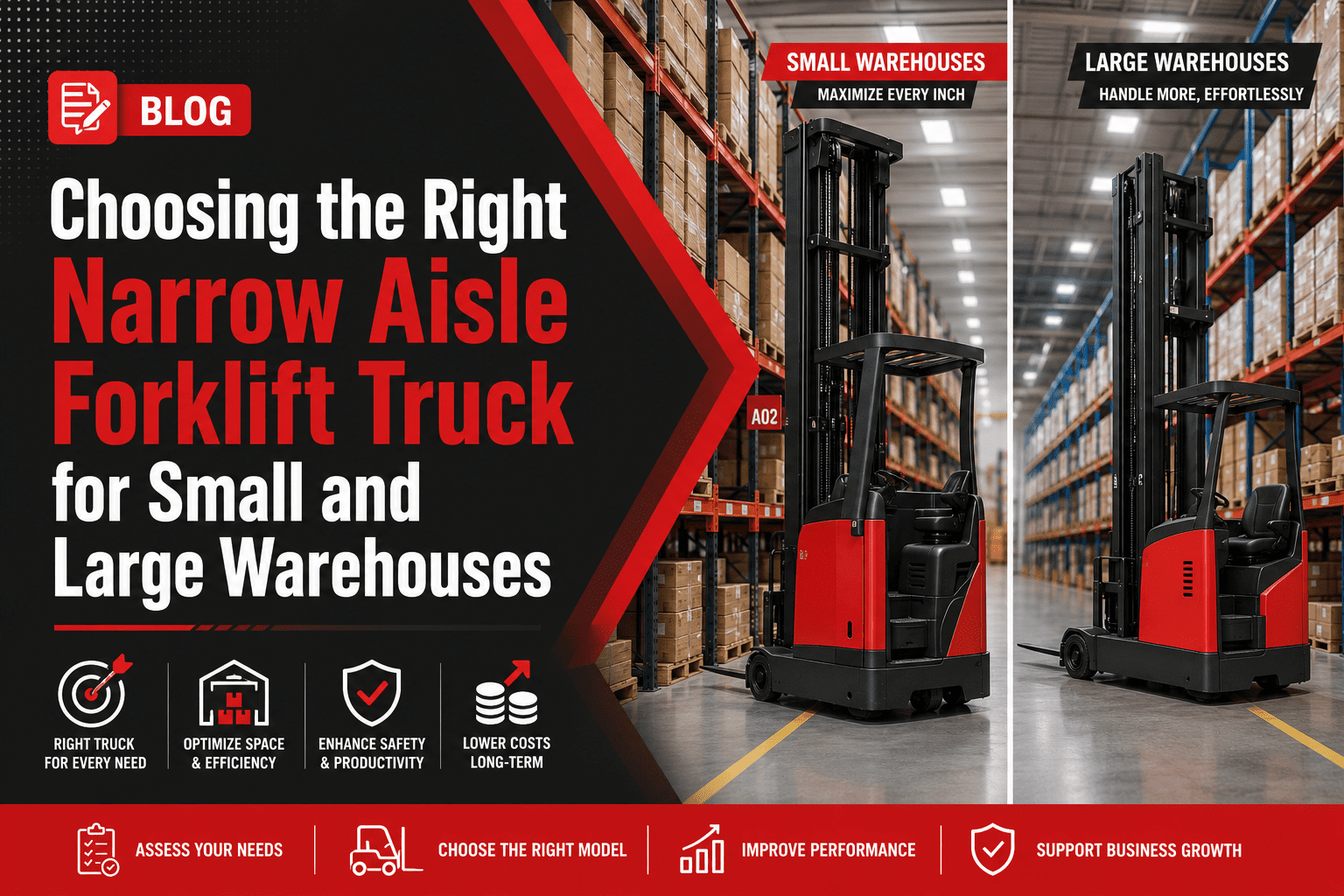
Warehouse efficiency today depends heavily on how effectively available storage space is utilized. As businesses continue to deal with rising inventory demands and increasing rental costs, maximizing every square meter of warehouse space has become more important than ever. This is where a reliable narrow aisle forklift truck becomes a valuable investment for both small and large warehouse operations.
Whether you manage a compact storage facility or a high-volume distribution center, choosing the right forklift directly impacts productivity, safety, inventory movement, and long-term operational costs. From maneuverability and lifting height to battery performance and aisle width compatibility, several practical factors should influence your buying decision.
Modern warehouse managers are increasingly investing in advanced warehouse material handling equipment to improve storage density without expanding warehouse size. However, selecting the wrong forklift can lead to operational delays, maintenance issues, and poor space optimization. This guide explains how to choose the right forklift based on warehouse size, workflow, load requirements, and operational goals.
Why Narrow Aisle Forklifts Are Important in Modern Warehouses
Traditional forklifts require wider turning spaces, which reduces available storage capacity. Narrow aisle forklifts are specifically engineered to operate efficiently in compact aisle environments while maintaining excellent lifting performance. The biggest advantage of a narrow aisle warehouse forklift is the ability to increase rack density without compromising operational flow. Businesses can create more storage locations while still allowing smooth movement of goods throughout the warehouse.
Warehouses using an aisle master forklift truck often benefit from the following:
- Better space utilization
- Faster inventory movement
- Reduced warehouse expansion costs
- Improved operator efficiency
- Higher vertical storage capability
- Better maneuverability in tight spaces
For companies managing fast-moving inventory, choosing the correct forklift can significantly improve overall warehouse productivity.
Understand Your Warehouse Size First
Before selecting any forklift, carefully evaluate your warehouse layout. A forklift suitable for a small warehouse may not perform efficiently in a large distribution center.
Small Warehouse Requirements
Smaller warehouses usually operate with:
- Limited aisle width
- Lower storage racks
- Moderate inventory movement
- Multi-purpose storage zones
In these environments, maneuverability becomes more important than extreme lifting height. A compact forklift for small warehouse operations should offer the following:
- Tight turning radius
- Compact body size
- Energy-efficient battery performance
- Easy operator handling
- Lower maintenance requirements
Electric-powered forklifts are often ideal for smaller facilities because they produce less noise and no exhaust emissions.
Large Warehouse Requirements
Larger warehouses typically require forklifts that can handle:
- Higher racking systems
- Continuous operations
- Long-distance travel
- Heavy lifting loads
- Multiple work shifts
In these settings, advanced VNA forklift truck systems are often preferred because they maximize vertical storage while maintaining precise handling in narrow aisles.
Choose the Right Forklift Type
Different warehouse operations require different forklift configurations. Understanding the available options helps avoid expensive purchasing mistakes.
Electric Narrow-Aisle Forklift
An electric narrow aisle forklift is one of the most common choices for indoor warehouses.
Benefits include:
- Quiet operation
- Lower fuel costs
- Reduced emissions
- Better indoor air quality
- Lower ongoing maintenance
Electric models are highly suitable for warehouses handling food products, pharmaceuticals, retail inventory, and electronics. Businesses aiming to improve energy efficiency often prefer electric forklifts because they reduce long-term operational costs.
Evaluate Aisle Width Compatibility
One of the most important buying considerations is aisle width. Even a high-performance forklift becomes inefficient if it cannot maneuver comfortably within the warehouse layout.
Measure:
- Rack-to-rack aisle width
- Turning space
- Loading zones
- Picking areas
- Dock access points
Choosing the wrong forklift size can slow operations and increase the risk of product damage. An experienced narrow aisle lift truck supplier can help assess your warehouse layout and recommend the correct equipment configuration.
Consider Lift Height Requirements
Warehouses today increasingly use vertical storage systems to maximize available space. Before selecting a forklift, evaluate your highest rack positions carefully.
Key questions include the following:
- What is the maximum lifting height needed?
- How stable is the forklift at full height?
- Does the forklift maintain lifting efficiency under load?
A properly selected all-master truck should provide both stability and precision at higher elevations without compromising operator safety.
Battery Performance Matters
Battery performance directly affects warehouse productivity, especially in multi-shift operations. When evaluating an electric forklift, consider:
- Charging time
- Battery lifespan
- Shift coverage capability
- Energy efficiency
- Maintenance requirements
Warehouses operating continuously may require spare battery systems or fast-charging solutions. Reliable battery performance becomes even more important in large warehouses where forklifts operate throughout the day.
Focus on Operator Comfort and Safety
Operator fatigue can reduce productivity and increase accident risks. Modern forklifts are designed with ergonomic features that improve operator efficiency during long shifts.
Important features include the following:
- Comfortable seating
- Clear visibility
- Easy steering controls
- Adjustable controls
- Stable mast design
- Smooth acceleration and braking
Safe forklift operation is especially critical in warehouses with narrow aisles and heavy traffic movement. Many companies investing in advanced warehouse material handling equipment now prioritize operator-friendly designs because they improve both safety and operational speed.
Assess Load Capacity Carefully
Every warehouse handles different load sizes and pallet weights. Choosing a forklift with insufficient load capacity can create safety issues and damage equipment over time.
Consider:
- Average pallet weight
- Maximum load requirements
- Load dimensions
- Rack height during lifting
Overloading forklifts significantly increases maintenance costs and reduces equipment lifespan.
Maintenance and Service Support
Buying the forklift itself is only part of the investment. Long-term service support is equally important.
Before purchasing, evaluate:
- Availability of spare parts
- Local service support
- Maintenance schedules
- Warranty coverage
- Technician availability
An experienced supplier can help minimize downtime and improve long-term forklift reliability. Businesses working with Paves Asia Pacific often prioritize service accessibility because consistent warehouse operations depend on reliable equipment support.
Think About Future Warehouse Growth
Many businesses purchase forklifts based only on current requirements. However, warehouse operations often expand over time.
Ask yourself:
- Will inventory volume increase?
- Will storage racks become taller?
- Will operational shifts expand?
- Will aisle configurations change?
Investing in scalable forklift solutions can help avoid expensive equipment upgrades later.
Compare Total Ownership Costs
The cheapest forklift option is not always the most cost-effective long-term.
Evaluate:
- Initial purchase price
- Battery replacement costs
- Maintenance expenses
- Energy consumption
- Downtime risk
- Service availability
An efficient forklift with lower operating costs often delivers better long-term value than a cheaper machine with frequent repairs.
Why Supplier Experience Matters
Choosing the right equipment partner is just as important as choosing the forklift itself. A knowledgeable supplier can assist with:
- Warehouse assessments
- Forklift recommendations
- Operator training
- Maintenance planning
- Spare parts management
Working with an experienced narrow aisle lift truck supplier helps businesses avoid costly equipment mismatches and operational inefficiencies.
Common Mistakes to Avoid
Many warehouse operators make avoidable purchasing mistakes when selecting forklifts.
- Ignoring Aisle Measurements
Improper measurements often result in maneuverability problems and storage inefficiency.
- Choosing Only Based on Price
Low-cost forklifts may lead to higher maintenance expenses later.
- Overlooking Service Support
Limited service access increases downtime risks.
- Ignoring Operator Comfort
Poor ergonomics reduce productivity and increase fatigue.
- Buying Without Future Planning
Warehouse growth can quickly outdate poorly planned forklift investments.
The Growing Demand for Narrow Aisle Forklifts
As warehouse rental costs continue increasing, businesses are focusing more on maximizing storage efficiency rather than expanding physical space. This growing demand has made narrow aisle forklift truck systems increasingly popular across industries such as:
- Retail distribution
- E-commerce fulfillment
- Food storage
- Pharmaceutical warehousing
- Manufacturing logistics
Modern forklifts now combine compact maneuverability with impressive lifting capabilities, making them suitable for a wide range of warehouse environments. Companies such as Paves Asia Pacific understand that efficient warehouse operations require forklifts that balance productivity, safety, energy efficiency, and long-term reliability.
Conclusion
Choosing the right forklift is a critical decision that directly affects warehouse efficiency, storage capacity, operational safety, and long-term costs. Whether you operate a compact storage facility or a high-volume logistics center, selecting the correct narrow aisle forklift truck helps maximize productivity while optimizing available warehouse space.
From lift height and battery performance to aisle compatibility and operator comfort, every detail matters when evaluating forklift options. Businesses that carefully assess their operational requirements before purchasing often experience better long-term performance and lower maintenance costs. A reliable electric narrow aisle forklift or advanced VNA forklift truck can dramatically improve warehouse operations when matched correctly to the facility’s layout and workflow requirements.
FAQs
Q1. What is the advantage of a narrow aisle forklift truck?
A1. A narrow aisle forklift truck helps maximize warehouse storage capacity by operating efficiently in compact aisle spaces.
Q2. Is an electric narrow aisle forklift suitable for small warehouses?
A2. Yes, electric forklifts are ideal for small warehouses because they offer compact maneuverability, low noise, and lower operating costs.
Q3. What is a VNA forklift truck used for?
A3. A VNA forklift truck is designed for very narrow aisle operations where maximizing vertical storage space is essential.
Q4. How do I choose the right forklift for small warehouse operations?
A4. Consider aisle width, load capacity, lifting height, battery performance, and future storage requirements before purchasing.
Q5. Why is supplier support important when buying warehouse forklifts?
A5. Reliable supplier support ensures easier maintenance, faster spare parts availability, and reduced operational downtime.